
'%3e%3cpath%20d='M12.0979%2019.9987C10.6974%2019.9987%209.29703%2019.4657%208.2309%2018.3995L1.60176%2011.7704C0.568828%2010.7375%200%209.36414%200%207.9034C0%206.44262%200.568828%205.06934%201.6018%204.03641C2.51562%203.12254%204.00258%203.12262%204.91633%204.03637L7.12605%206.2461C8.03988%207.15992%208.03988%208.6468%207.12605%209.56067C6.97848%209.70821%206.89723%209.90442%206.89723%2010.1131C6.89723%2010.3218%206.97848%2010.5179%207.12602%2010.6655L9.33574%2012.8752C9.48328%2013.0228%209.67949%2013.1041%209.88816%2013.1041C10.0969%2013.1041%2010.293%2013.0228%2010.4406%2012.8753C11.3545%2011.9614%2012.8414%2011.9614%2013.7552%2012.8753L15.9649%2015.085C16.8787%2015.9988%2016.8787%2017.4857%2015.9649%2018.3995C14.8987%2019.4657%2013.4983%2019.9987%2012.0979%2019.9987ZM3.25906%204.91281C3.05898%204.91281%202.85895%204.98895%202.7066%205.14129C1.96883%205.87906%201.5625%206.86%201.5625%207.9034C1.5625%208.9468%201.96883%209.92774%202.7066%2010.6655L9.33574%2017.2947C10.8587%2018.8177%2013.337%2018.8177%2014.86%2017.2947C15.1646%2016.99%2015.1646%2016.4944%2014.86%2016.1898L12.6503%2013.9801C12.5028%2013.8325%2012.3066%2013.7513%2012.0979%2013.7513C11.8892%2013.7513%2011.693%2013.8325%2011.5455%2013.98C10.6316%2014.8939%209.14473%2014.8939%208.23086%2013.98L6.02117%2011.7703C5.57852%2011.3277%205.33473%2010.7391%205.33473%2010.113C5.33473%209.48703%205.57852%208.89844%206.02117%208.45578C6.16875%208.30824%206.25%208.11203%206.25%207.90336C6.25%207.69469%206.16875%207.49852%206.02117%207.35094L3.81148%205.14121C3.65918%204.98899%203.4591%204.91281%203.25906%204.91281Z'%20fill='black'/%3e%3cpath%20d='M9.5448%209.3168C9.25285%209.1959%209.0625%208.91102%209.0625%208.59504V0.782539C9.0625%200.351055%209.41227%200.00128937%209.84375%200.00128937H19.2188C19.6502%200.00128937%2020%200.351055%2020%200.782539V7.03254C20%207.46402%2019.6502%207.81379%2019.2188%207.81379H11.7298L10.3962%209.14746C10.1728%209.3709%209.83676%209.43773%209.5448%209.3168ZM10.625%201.56379V6.70895L10.8538%206.48012C11.0003%206.33359%2011.199%206.25129%2011.4062%206.25129H18.4375V1.56379H10.625Z'%20fill='black'/%3e%3cpath%20d='M12.9688%204.68879C13.4002%204.68879%2013.75%204.33901%2013.75%203.90754C13.75%203.47607%2013.4002%203.12629%2012.9688%203.12629C12.5373%203.12629%2012.1875%203.47607%2012.1875%203.90754C12.1875%204.33901%2012.5373%204.68879%2012.9688%204.68879Z'%20fill='black'/%3e%3cpath%20d='M16.0938%204.68879C16.5252%204.68879%2016.875%204.33901%2016.875%203.90754C16.875%203.47607%2016.5252%203.12629%2016.0938%203.12629C15.6623%203.12629%2015.3125%203.47607%2015.3125%203.90754C15.3125%204.33901%2015.6623%204.68879%2016.0938%204.68879Z'%20fill='black'/%3e%3c/g%3e%3cdefs%3e%3cclipPath%20id='clip0_6353_9'%3e%3crect%20width='20'%20height='20'%20fill='white'/%3e%3c/clipPath%3e%3c/defs%3e%3c/svg%3e)
'%3e%3cpath%20d='M10%2020C13.8389%2020%2017.0312%2018.3836%2017.0312%2016.0938C17.0312%2015.4405%2016.7592%2014.8022%2016.2444%2014.2478C15.9508%2013.9316%2015.4565%2013.9132%2015.1403%2014.2068C14.8241%2014.5004%2014.8058%2014.9947%2015.0994%2015.3109C15.3444%2015.5749%2015.4687%2015.8383%2015.4687%2016.0938C15.4687%2017.2001%2013.13%2018.4375%209.99996%2018.4375C6.86996%2018.4375%204.53121%2017.2001%204.53121%2016.0938C4.53121%2015.8382%204.65547%2015.5749%204.90055%2015.3109C5.19414%2014.9947%205.17582%2014.5004%204.85965%2014.2068C4.54348%2013.9133%204.04914%2013.9316%203.75555%2014.2477C3.24082%2014.8021%202.96875%2015.4405%202.96875%2016.0938C2.96875%2018.3803%206.15578%2020%2010%2020Z'%20fill='black'/%3e%3cpath%20d='M8.13172%2015.9465C8.57285%2016.5282%209.27023%2016.875%2010%2016.875C10.7298%2016.875%2011.4271%2016.5282%2011.8683%2015.9466L15.6293%2011.2402C16.5465%2010.0163%2017.0312%208.5609%2017.0312%207.03125C17.0312%203.15422%2013.877%200%2010%200C6.12297%200%202.96875%203.15422%202.96875%207.03125C2.96875%208.56094%203.45352%2010.0164%204.37063%2011.2402L8.13172%2015.9465ZM10%201.5625C13.0155%201.5625%2015.4688%204.01578%2015.4688%207.03125C15.4688%208.21648%2015.0944%209.34434%2014.386%2010.2938C14.386%2010.2938%2010.6309%2014.9924%2010.626%2014.9989C10.4766%2015.1982%2010.2484%2015.3125%2010%2015.3125C9.75156%2015.3125%209.5234%2015.1982%209.37402%2014.9989C9.36914%2014.9923%209.36418%2014.9859%209.3591%2014.9796L5.61395%2010.2937C4.90559%209.34434%204.53125%208.21652%204.53125%207.03125C4.53125%204.01578%206.98453%201.5625%2010%201.5625Z'%20fill='black'/%3e%3cpath%20d='M10%2010.9375C12.1539%2010.9375%2013.9062%209.18516%2013.9062%207.03125C13.9062%204.87734%2012.1539%203.125%2010%203.125C7.84609%203.125%206.09375%204.87734%206.09375%207.03125C6.09375%209.18516%207.84609%2010.9375%2010%2010.9375ZM10%204.6875C11.2923%204.6875%2012.3438%205.73891%2012.3438%207.03125C12.3438%208.32359%2011.2923%209.375%2010%209.375C8.70766%209.375%207.65625%208.32359%207.65625%207.03125C7.65625%205.73891%208.70766%204.6875%2010%204.6875Z'%20fill='black'/%3e%3c/g%3e%3cdefs%3e%3cclipPath%20id='clip0_6353_60'%3e%3crect%20width='20'%20height='20'%20fill='white'/%3e%3c/clipPath%3e%3c/defs%3e%3c/svg%3e)

'%3e%3ccircle%20cx='321'%20cy='321'%20r='276'%20transform='matrix(-1%200%200%201%20481%200)'%20stroke='%23E5DFD3'%20stroke-width='90'/%3e%3c/g%3e%3cdefs%3e%3cclipPath%20id='clip0_6046_3421'%3e%3crect%20width='481'%20height='413'%20fill='white'%20transform='matrix(-1%200%200%201%20481%200)'/%3e%3c/clipPath%3e%3c/defs%3e%3c/svg%3e)
Does Tirzepatide Cause Heart Palpitations
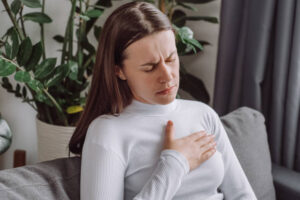
Does Tirzepatide cause heart palpitations? It can be unsettling to notice a heart that feels like it’s racing, fluttering, or pounding when starting a new medicine. Understanding when such feelings are normal, temporary, or a reason to see a doctor provides helpful clarity.
Tirzepatide has an impact on how the body manages appetite, blood sugar, and overall metabolic processes. These shifts might influence hydration levels, blood pressure, and how active the nervous system is. Sometimes, these changes can make individuals more conscious of their heartbeat. Learn what’s normal and what’s not with us today.
Key Takeaways
- Heart palpitations don’t occur as a direct side effect.
- Temporary symptoms come from indirect causes.
- Blood pressure changes and hydration levels have an influence.
- Feeling anxious can make people more aware of their heartbeat.
- Checking with a doctor can rule out heart problems.
What Heart Palpitations Feel Like
Heart palpitations mean you notice your heartbeat more than usual, not that there is always an issue. Some might feel it as pounding, fluttering, or even a skipped beat, whether they’re active or sitting still. How strong or long it lasts can differ from person to person.
Palpitations happen due to shifts in heart rate instead of severe rhythm issues. Things like caffeine stress, not drinking enough water, or lack of sleep often lead to these feelings. Medications might affect these triggers too.
Most palpitations don’t last long and aren’t harmful. Knowing what triggers them can ease unnecessary worry. Spotting patterns is more helpful than focusing on random episodes.
Let our team know how we can help with your goals!
Can Tirzepatide Cause Palpitations?
Tirzepatide has no clear link to causing irregular heartbeats. Data from clinical trials does not connect it with arrhythmias. Still, a few people report feeling a racing heart in the early stages of treatment.
These cases result from indirect factors. Eating less could reduce fluid intake. This might cause short-term changes in blood pressure.
Your heart may beat faster as it adjusts to these changes. These feelings tend to improve when people stay hydrated and keep their intake steady. Watching symptoms can often determine what’s happening.
Blood Pressure Shifts And Noticing Your Heartbeat
Managing blood pressure has an impact on feelings of palpitations. Tirzepatide tends to enhance heart health measurements. Some people notice their blood pressure decreases in the treatment period.
A quick drop in blood pressure may cause dizziness or a fast heartbeat. These issues often show up when someone stands or is dehydrated. Drinking water helps fix the problem.
Doctors’ understanding of blood pressure effects highlights how changes in metabolism can change how heartbeats feel. Learning about this link can ease worries for many patients. /faqs/does-tirzepatide-lower-blood-pressure/
To discuss our services, contact us today!
Worry and Nerve System Reactions
The nervous system has a big influence on how we feel our heartbeat. Starting a new medication might cause stress or anxiety. This can lead the body to release adrenaline.
Adrenaline speeds up the heart and heightens awareness. People may notice feelings in their chest that they didn’t have before. It might feel scary, but it’s not harmful.
Losing weight changes cortisol and other stress hormones. These shifts can make people more sensitive for a short time. These feelings ease once the body adjusts to the new routine.
Need help deciding? Fill out a contact form,and we’ll ensure you’re informed!
Hydration and Balancing Electrolytes
Staying hydrated affects how the heart sends signals. Eating less might also lower how much sodium, potassium, or magnesium you take in. Keeping these minerals balanced is important.
When electrolytes shift, heart palpitations may happen even if the heart is healthy. Drinking enough water can help steady the heart’s signals. Eating a balanced diet supports this as well.
Patients should not take supplements without professional advice. Doctors use lab tests to find deficiencies when needed. Fixing these issues often helps symptoms go away.
How Cholesterol Levels and Heart Health are Related
Better metabolism can lead to stronger heart health over time. Tirzepatide helps many people improve their cholesterol levels. Lowering cholesterol can ease the burden on the heart.
Doctors provide advice about changes in cholesterol and explain how a healthier metabolism helps blood vessels work better. These benefits are more important than short-term discomforts.
Palpitations that occur during treatment suggest a serious problem. The overall risk to heart health gets better. Understanding the bigger picture is crucial to explaining these symptoms.
Blood Clots and Palpitations Are Separate Concerns
Some people mistake palpitations for signs of a blood clot. Blood clots bring swelling, pain, or sudden trouble breathing. Palpitations on their own do not mean a blood clot has formed.
To avoid unnecessary stress, patients need a clear understanding of blood clot risks. Learning about this can help them react. Any sudden intense symptoms need urgent attention. Doctors must explain warning signs. Knowing the difference between conditions helps ensure safety.
When to Get Palpitations Checked by a Doctor
Most palpitations are not dangerous, but certain situations call for medical attention.
- Episodes that last several hours or happen every day need to be checked out.
- Chest pain occurring alongside palpitations is more alarming and should be addressed.
- Do not overlook fainting, trouble breathing, or feeling dizzy.
People with existing heart problems should have their health checked more often. Medicines might react with each other and play a role. Seeing a doctor can ease concerns. Serious problems are rare, but avoiding them avoids bigger issues.
Keeping Track of Care And Symptoms During Treatment
People dealing with palpitations do well with regular medical check-ups while managing metabolism. Keeping track of progress shows the difference between normal changes and things that might need fixing. Doctors check blood pressure, hydration levels, and how symptoms develop all at once.
This combined method is a key part of tirzepatide treatment, where patients attend follow-up visits to stay informed about heart health and manage their weight. Staying in touch helps lower stress. Doctors make changes ahead of issues. Consistency leads to better results.
What Studies Reveal About Tirzepatide and Heart Health
Major studies confirm its safety for the heart rhythm. Researchers found that tirzepatide does not raise the risk of arrhythmias in trials. It often helps with heart health outcomes.
Based on cardiovascular safety data, dual-agonist therapy shows either neutral or positive effects on the heart. This gives doctors more assurance in using this treatment. More cardiac outcome studies also show that better insulin sensitivity helps the heart work better. Healthy metabolism supports blood vessel function.
How Trim Body M.D. Tracks Heart Health During Treatment
At Trim Body M.D., the focus on heart health begins as soon as metabolic therapy starts. Experts evaluate your symptoms, check your vitals, and review your medical history as a whole. This combined process prioritizes your well-being. Here is how patients gain:
- Monitoring blood pressure
- Checking symptom patterns
- Delivering care shaped by 30,000+ patients
- Reviewing how medications may interact
- Providing advice on staying hydrated and eating well
Things To Remember During Treatment
So, does tirzepatide cause heart palpitations for most patients? Research shows it causes palpitations, and when it does, they are indirect. With proper hydration, careful monitoring, and professional guidance, most people continue using it both and with peace of mind. Book a medical appointment with us today.
Disclaimer: This article is for informational and educational purposes. Treatment decisions are made during an individual medical evaluation with a licensed provider. We provide compounded tirzepatide and are not affiliated with or endorsed by the manufacturers of Zepbound® or Mounjaro®.
FAQs About Tirzepatide And Heart Palpitations
Are Heart Palpitations Common When Starting Tirzepatide?
No. Palpitations are not commonly reported in clinical studies. When they occur, they usually relate to hydration, blood pressure changes, or anxiety rather than heart rhythm problems.
Can Dehydration From Tirzepatide Trigger Palpitations?
Yes. Reduced appetite can lower fluid intake, which may increase heartbeat awareness. Maintaining hydration often reduces symptoms quickly.
Should I Stop Tirzepatide If I Notice Palpitations?
Not immediately. Mild, brief palpitations often resolve with hydration and monitoring. Contact a clinician before making medication changes.
Do Palpitations Mean Tirzepatide Is Affecting My Heart?
Usually no. Most palpitations reflect indirect metabolic or nervous system changes. Medical evaluation confirms whether the heart itself is involved.
When Are Palpitations A Medical Emergency?
Palpitations with chest pain, fainting, or severe shortness of breath need urgent care. Persistent episodes also warrant medical review.
Call and talk to a specialist today! (702) 489-3300
Let our team know how we can help with your goals!

Get In Touch With Us
Schedule Your Free Consultation — Take Your First Step Today
 Henderson
Let our team of Medical Professionals help you achieve your body goals. Contact us Today!