
'%3e%3cpath%20d='M12.0979%2019.9987C10.6974%2019.9987%209.29703%2019.4657%208.2309%2018.3995L1.60176%2011.7704C0.568828%2010.7375%200%209.36414%200%207.9034C0%206.44262%200.568828%205.06934%201.6018%204.03641C2.51562%203.12254%204.00258%203.12262%204.91633%204.03637L7.12605%206.2461C8.03988%207.15992%208.03988%208.6468%207.12605%209.56067C6.97848%209.70821%206.89723%209.90442%206.89723%2010.1131C6.89723%2010.3218%206.97848%2010.5179%207.12602%2010.6655L9.33574%2012.8752C9.48328%2013.0228%209.67949%2013.1041%209.88816%2013.1041C10.0969%2013.1041%2010.293%2013.0228%2010.4406%2012.8753C11.3545%2011.9614%2012.8414%2011.9614%2013.7552%2012.8753L15.9649%2015.085C16.8787%2015.9988%2016.8787%2017.4857%2015.9649%2018.3995C14.8987%2019.4657%2013.4983%2019.9987%2012.0979%2019.9987ZM3.25906%204.91281C3.05898%204.91281%202.85895%204.98895%202.7066%205.14129C1.96883%205.87906%201.5625%206.86%201.5625%207.9034C1.5625%208.9468%201.96883%209.92774%202.7066%2010.6655L9.33574%2017.2947C10.8587%2018.8177%2013.337%2018.8177%2014.86%2017.2947C15.1646%2016.99%2015.1646%2016.4944%2014.86%2016.1898L12.6503%2013.9801C12.5028%2013.8325%2012.3066%2013.7513%2012.0979%2013.7513C11.8892%2013.7513%2011.693%2013.8325%2011.5455%2013.98C10.6316%2014.8939%209.14473%2014.8939%208.23086%2013.98L6.02117%2011.7703C5.57852%2011.3277%205.33473%2010.7391%205.33473%2010.113C5.33473%209.48703%205.57852%208.89844%206.02117%208.45578C6.16875%208.30824%206.25%208.11203%206.25%207.90336C6.25%207.69469%206.16875%207.49852%206.02117%207.35094L3.81148%205.14121C3.65918%204.98899%203.4591%204.91281%203.25906%204.91281Z'%20fill='black'/%3e%3cpath%20d='M9.5448%209.3168C9.25285%209.1959%209.0625%208.91102%209.0625%208.59504V0.782539C9.0625%200.351055%209.41227%200.00128937%209.84375%200.00128937H19.2188C19.6502%200.00128937%2020%200.351055%2020%200.782539V7.03254C20%207.46402%2019.6502%207.81379%2019.2188%207.81379H11.7298L10.3962%209.14746C10.1728%209.3709%209.83676%209.43773%209.5448%209.3168ZM10.625%201.56379V6.70895L10.8538%206.48012C11.0003%206.33359%2011.199%206.25129%2011.4062%206.25129H18.4375V1.56379H10.625Z'%20fill='black'/%3e%3cpath%20d='M12.9688%204.68879C13.4002%204.68879%2013.75%204.33901%2013.75%203.90754C13.75%203.47607%2013.4002%203.12629%2012.9688%203.12629C12.5373%203.12629%2012.1875%203.47607%2012.1875%203.90754C12.1875%204.33901%2012.5373%204.68879%2012.9688%204.68879Z'%20fill='black'/%3e%3cpath%20d='M16.0938%204.68879C16.5252%204.68879%2016.875%204.33901%2016.875%203.90754C16.875%203.47607%2016.5252%203.12629%2016.0938%203.12629C15.6623%203.12629%2015.3125%203.47607%2015.3125%203.90754C15.3125%204.33901%2015.6623%204.68879%2016.0938%204.68879Z'%20fill='black'/%3e%3c/g%3e%3cdefs%3e%3cclipPath%20id='clip0_6353_9'%3e%3crect%20width='20'%20height='20'%20fill='white'/%3e%3c/clipPath%3e%3c/defs%3e%3c/svg%3e)
'%3e%3cpath%20d='M10%2020C13.8389%2020%2017.0312%2018.3836%2017.0312%2016.0938C17.0312%2015.4405%2016.7592%2014.8022%2016.2444%2014.2478C15.9508%2013.9316%2015.4565%2013.9132%2015.1403%2014.2068C14.8241%2014.5004%2014.8058%2014.9947%2015.0994%2015.3109C15.3444%2015.5749%2015.4687%2015.8383%2015.4687%2016.0938C15.4687%2017.2001%2013.13%2018.4375%209.99996%2018.4375C6.86996%2018.4375%204.53121%2017.2001%204.53121%2016.0938C4.53121%2015.8382%204.65547%2015.5749%204.90055%2015.3109C5.19414%2014.9947%205.17582%2014.5004%204.85965%2014.2068C4.54348%2013.9133%204.04914%2013.9316%203.75555%2014.2477C3.24082%2014.8021%202.96875%2015.4405%202.96875%2016.0938C2.96875%2018.3803%206.15578%2020%2010%2020Z'%20fill='black'/%3e%3cpath%20d='M8.13172%2015.9465C8.57285%2016.5282%209.27023%2016.875%2010%2016.875C10.7298%2016.875%2011.4271%2016.5282%2011.8683%2015.9466L15.6293%2011.2402C16.5465%2010.0163%2017.0312%208.5609%2017.0312%207.03125C17.0312%203.15422%2013.877%200%2010%200C6.12297%200%202.96875%203.15422%202.96875%207.03125C2.96875%208.56094%203.45352%2010.0164%204.37063%2011.2402L8.13172%2015.9465ZM10%201.5625C13.0155%201.5625%2015.4688%204.01578%2015.4688%207.03125C15.4688%208.21648%2015.0944%209.34434%2014.386%2010.2938C14.386%2010.2938%2010.6309%2014.9924%2010.626%2014.9989C10.4766%2015.1982%2010.2484%2015.3125%2010%2015.3125C9.75156%2015.3125%209.5234%2015.1982%209.37402%2014.9989C9.36914%2014.9923%209.36418%2014.9859%209.3591%2014.9796L5.61395%2010.2937C4.90559%209.34434%204.53125%208.21652%204.53125%207.03125C4.53125%204.01578%206.98453%201.5625%2010%201.5625Z'%20fill='black'/%3e%3cpath%20d='M10%2010.9375C12.1539%2010.9375%2013.9062%209.18516%2013.9062%207.03125C13.9062%204.87734%2012.1539%203.125%2010%203.125C7.84609%203.125%206.09375%204.87734%206.09375%207.03125C6.09375%209.18516%207.84609%2010.9375%2010%2010.9375ZM10%204.6875C11.2923%204.6875%2012.3438%205.73891%2012.3438%207.03125C12.3438%208.32359%2011.2923%209.375%2010%209.375C8.70766%209.375%207.65625%208.32359%207.65625%207.03125C7.65625%205.73891%208.70766%204.6875%2010%204.6875Z'%20fill='black'/%3e%3c/g%3e%3cdefs%3e%3cclipPath%20id='clip0_6353_60'%3e%3crect%20width='20'%20height='20'%20fill='white'/%3e%3c/clipPath%3e%3c/defs%3e%3c/svg%3e)

'%3e%3ccircle%20cx='321'%20cy='321'%20r='276'%20transform='matrix(-1%200%200%201%20481%200)'%20stroke='%23E5DFD3'%20stroke-width='90'/%3e%3c/g%3e%3cdefs%3e%3cclipPath%20id='clip0_6046_3421'%3e%3crect%20width='481'%20height='413'%20fill='white'%20transform='matrix(-1%200%200%201%20481%200)'/%3e%3c/clipPath%3e%3c/defs%3e%3c/svg%3e)
Does Tirzepatide Cause Blood Clots?
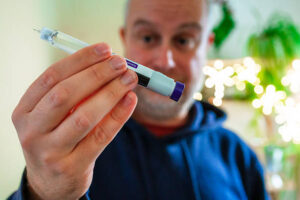
Worries about staying safe while using medication make sense when the news highlights blood clots. Now, does tirzepatide cause blood clots? They look for answers backed by solid medical facts. Knowing the real dangers as opposed to the imagined ones helps people choose treatments and feel more confident about their decisions.
We understand as healthcare providers how myths or wrong information can add to stress. At TrimBody M.D, teaching patients is an important part of making sure care is safe.
Key takeaways:
- Tirzepatide does not fall into the category of clot-forming drugs.
- Studies done in trials have not linked it to higher clot risks.
- Losing weight reduces the chance of clots over time.
- A person’s own risk factors play a bigger role than the medicine itself.
- Regular check-ups with doctors catch unusual issues.
What Are Blood Clots And Why Are They A Concern?
Blood clots happen when blood thickens and sticks together inside a vessel. This response helps the body heal injuries, but clots forming when they are not needed can block blood flow. Deep vein thrombosis and pulmonary embolism are two important risks people often worry about.
People often worry about medications when they affect things like blood flow, inflammation, or hormones. Since tirzepatide has an impact on metabolism and the pathways linked to inflammation, it makes sense for patients to wonder if it could raise the risk of blood clots.
Right now, prescribing information does not include blood clots as a reported or expected side effect of tirzepatide.
Let our team know how we can help with your goals!
Does Tirzepatide Cause Blood Clots According To Research?
The simple answer is no. Large trials and post-marketing safety data do not show a higher risk of blood clots associated with tirzepatide use.
A comprehensive safety review published in peer-reviewed medical literature found no consistent evidence linking GLP-1–based therapies to clotting events, even across diverse patient populations.
Separate cardiometabolic analyses examining vascular outcomes reported neutral or beneficial effects on blood vessels, with no signals of clot-promoting activity.
How Tirzepatide Affects Inflammation and Blood Vessel Health
Clotting is closely linked to inflammation. Chronic inflammation can thicken blood and increase platelet activity, raising clot risk over time. Research shows tirzepatide lowers markers of systemic inflammation, which may help reduce conditions that support clot formation.
This effect is discussed in clinical research on reducing inflammation during tirzepatide treatment. Decreasing inflammation can often make blood vessels work better and improve how blood flows.
Weight Loss and Blood Clot Risk
Doctors know obesity is a key reason behind higher risks of blood clots. Carrying extra weight puts more pressure on veins, slows circulation, and triggers inflammation in the body. Losing weight over time helps blood flow better and cuts down the chance of clots.
Tirzepatide helps promote fat loss while preserving lean muscle mass, which supports a steadier metabolic rate during weight reduction. Maintaining muscle is important for long-term metabolic health and physical function. Evidence on burning fat explains how this process occurs during treatment.
Improving the way metabolism works often lowers the risk of clots instead of raising it.
Who Might Have a Higher Risk of Blood Clots?
The chances of blood clots are more influenced by a person’s health than by taking tirzepatide itself. Doctors need to watch patients who have these conditions:
- A history of deep vein thrombosis or pulmonary embolism
- Diagnosed with clotting disorders
- Long periods of inactivity or had surgery
- Those undergoing cancer treatment or hormone therapies
It’s critical to let a healthcare provider make tailored treatment choices based on each person’s situation.
To discuss our services, contact us today!
Symptoms You Should Not Overlook
While tirzepatide does not lead to blood clots, patients must get medical help if they notice sudden symptoms. Some key warning signals are:
- Swelling or pain in one leg
- Sharp chest pain or trouble breathing
- A limb becoming red or warm to the touch
These symptoms need immediate medical attention, no matter what medications a person is taking.
Safe Use of Tirzepatide
Doctors oversee tirzepatide prescriptions to make sure doses are correct, and patients are monitored. TrimBody’s Laguna Beach tirzepatide program, check for risks and provide ongoing care. This approach identifies uncommon side effects and keeps patients safer in the long run.
Need help deciding? Fill out a contact form,and we’ll ensure you’re informed!
What Our Clinic Does To Keep Patients Safe
At TrimBody M.D, our team checks medical history, heart health risks, and metabolism indicators before beginning any treatment. We track your progress and provide education, ensuring issues like blood clots are handled instead of after they occur.
- Assess personal risks before starting treatment
- Teach ways to improve circulation and movement
- Keep track of changes when doses are adjusted
- Encourage proper hydration and regular activity
- Offer clear advice on when to seek medical help
We focus on keeping you safe, informed, and aiming for lasting results.
Things You Should Know Before Starting
So, does tirzepatide cause blood clots? Right now, the evidence suggests it does not. Blood clots are not listed as a side effect, and the drug’s positive effects on metabolism might even help with vascular health. Your personal risk factors are the most important, which is why working with a healthcare provider is crucial.
To get advice tailored to your health needs, talk to a licensed medical professional before you begin or change treatments. Reach out to our medical team to schedule a consultation today.
Disclaimer: This article is for informational and educational purposes. Treatment decisions are made during an individual medical evaluation with a licensed provider. We provide compounded tirzepatide and are not affiliated with or endorsed by the manufacturers of Zepbound® or Mounjaro®.
FAQs about Tirzepatide and Blood Clots
Can Tirzepatide Increase My Risk If I’ve Had Blood Clots Before?
A prior clot history raises baseline risk regardless of medication. A clinician should review your history and decide if tirzepatide fits safely within your overall cardiovascular and clot-prevention plan.
Are Blood Clots Listed As A Known Side Effect Of Tirzepatide?
No. Blood clots are not listed as a common or expected adverse effect in clinical trials or prescribing information for tirzepatide.
Can Rapid Weight Loss Itself Affect Clot Risk?
Yes. Rapid weight changes can temporarily affect hydration and circulation, which is why medical monitoring matters. Long-term weight loss usually lowers clot risk by improving blood flow and reducing inflammation.
Should I Stop Tirzepatide Before Surgery Or Long Travel?
In some cases, yes. Your provider may advise pausing treatment around surgery or prolonged immobility to reduce clot risk and manage hydration safely.
What Symptoms Should Prompt Immediate Medical Attention?
Sudden leg swelling, chest pain, or shortness of breath requires urgent care. These symptoms are emergencies regardless of medication use and should never be monitored at home.
Call and talk to a specialist today! (702) 489-3300
Let our team know how we can help with your goals!

Get In Touch With Us
Schedule Your Free Consultation — Take Your First Step Today
 Henderson
Let our team of Medical Professionals help you achieve your body goals. Contact us Today!