
'%3e%3cpath%20d='M12.0979%2019.9987C10.6974%2019.9987%209.29703%2019.4657%208.2309%2018.3995L1.60176%2011.7704C0.568828%2010.7375%200%209.36414%200%207.9034C0%206.44262%200.568828%205.06934%201.6018%204.03641C2.51562%203.12254%204.00258%203.12262%204.91633%204.03637L7.12605%206.2461C8.03988%207.15992%208.03988%208.6468%207.12605%209.56067C6.97848%209.70821%206.89723%209.90442%206.89723%2010.1131C6.89723%2010.3218%206.97848%2010.5179%207.12602%2010.6655L9.33574%2012.8752C9.48328%2013.0228%209.67949%2013.1041%209.88816%2013.1041C10.0969%2013.1041%2010.293%2013.0228%2010.4406%2012.8753C11.3545%2011.9614%2012.8414%2011.9614%2013.7552%2012.8753L15.9649%2015.085C16.8787%2015.9988%2016.8787%2017.4857%2015.9649%2018.3995C14.8987%2019.4657%2013.4983%2019.9987%2012.0979%2019.9987ZM3.25906%204.91281C3.05898%204.91281%202.85895%204.98895%202.7066%205.14129C1.96883%205.87906%201.5625%206.86%201.5625%207.9034C1.5625%208.9468%201.96883%209.92774%202.7066%2010.6655L9.33574%2017.2947C10.8587%2018.8177%2013.337%2018.8177%2014.86%2017.2947C15.1646%2016.99%2015.1646%2016.4944%2014.86%2016.1898L12.6503%2013.9801C12.5028%2013.8325%2012.3066%2013.7513%2012.0979%2013.7513C11.8892%2013.7513%2011.693%2013.8325%2011.5455%2013.98C10.6316%2014.8939%209.14473%2014.8939%208.23086%2013.98L6.02117%2011.7703C5.57852%2011.3277%205.33473%2010.7391%205.33473%2010.113C5.33473%209.48703%205.57852%208.89844%206.02117%208.45578C6.16875%208.30824%206.25%208.11203%206.25%207.90336C6.25%207.69469%206.16875%207.49852%206.02117%207.35094L3.81148%205.14121C3.65918%204.98899%203.4591%204.91281%203.25906%204.91281Z'%20fill='black'/%3e%3cpath%20d='M9.5448%209.3168C9.25285%209.1959%209.0625%208.91102%209.0625%208.59504V0.782539C9.0625%200.351055%209.41227%200.00128937%209.84375%200.00128937H19.2188C19.6502%200.00128937%2020%200.351055%2020%200.782539V7.03254C20%207.46402%2019.6502%207.81379%2019.2188%207.81379H11.7298L10.3962%209.14746C10.1728%209.3709%209.83676%209.43773%209.5448%209.3168ZM10.625%201.56379V6.70895L10.8538%206.48012C11.0003%206.33359%2011.199%206.25129%2011.4062%206.25129H18.4375V1.56379H10.625Z'%20fill='black'/%3e%3cpath%20d='M12.9688%204.68879C13.4002%204.68879%2013.75%204.33901%2013.75%203.90754C13.75%203.47607%2013.4002%203.12629%2012.9688%203.12629C12.5373%203.12629%2012.1875%203.47607%2012.1875%203.90754C12.1875%204.33901%2012.5373%204.68879%2012.9688%204.68879Z'%20fill='black'/%3e%3cpath%20d='M16.0938%204.68879C16.5252%204.68879%2016.875%204.33901%2016.875%203.90754C16.875%203.47607%2016.5252%203.12629%2016.0938%203.12629C15.6623%203.12629%2015.3125%203.47607%2015.3125%203.90754C15.3125%204.33901%2015.6623%204.68879%2016.0938%204.68879Z'%20fill='black'/%3e%3c/g%3e%3cdefs%3e%3cclipPath%20id='clip0_6353_9'%3e%3crect%20width='20'%20height='20'%20fill='white'/%3e%3c/clipPath%3e%3c/defs%3e%3c/svg%3e)
'%3e%3cpath%20d='M10%2020C13.8389%2020%2017.0312%2018.3836%2017.0312%2016.0938C17.0312%2015.4405%2016.7592%2014.8022%2016.2444%2014.2478C15.9508%2013.9316%2015.4565%2013.9132%2015.1403%2014.2068C14.8241%2014.5004%2014.8058%2014.9947%2015.0994%2015.3109C15.3444%2015.5749%2015.4687%2015.8383%2015.4687%2016.0938C15.4687%2017.2001%2013.13%2018.4375%209.99996%2018.4375C6.86996%2018.4375%204.53121%2017.2001%204.53121%2016.0938C4.53121%2015.8382%204.65547%2015.5749%204.90055%2015.3109C5.19414%2014.9947%205.17582%2014.5004%204.85965%2014.2068C4.54348%2013.9133%204.04914%2013.9316%203.75555%2014.2477C3.24082%2014.8021%202.96875%2015.4405%202.96875%2016.0938C2.96875%2018.3803%206.15578%2020%2010%2020Z'%20fill='black'/%3e%3cpath%20d='M8.13172%2015.9465C8.57285%2016.5282%209.27023%2016.875%2010%2016.875C10.7298%2016.875%2011.4271%2016.5282%2011.8683%2015.9466L15.6293%2011.2402C16.5465%2010.0163%2017.0312%208.5609%2017.0312%207.03125C17.0312%203.15422%2013.877%200%2010%200C6.12297%200%202.96875%203.15422%202.96875%207.03125C2.96875%208.56094%203.45352%2010.0164%204.37063%2011.2402L8.13172%2015.9465ZM10%201.5625C13.0155%201.5625%2015.4688%204.01578%2015.4688%207.03125C15.4688%208.21648%2015.0944%209.34434%2014.386%2010.2938C14.386%2010.2938%2010.6309%2014.9924%2010.626%2014.9989C10.4766%2015.1982%2010.2484%2015.3125%2010%2015.3125C9.75156%2015.3125%209.5234%2015.1982%209.37402%2014.9989C9.36914%2014.9923%209.36418%2014.9859%209.3591%2014.9796L5.61395%2010.2937C4.90559%209.34434%204.53125%208.21652%204.53125%207.03125C4.53125%204.01578%206.98453%201.5625%2010%201.5625Z'%20fill='black'/%3e%3cpath%20d='M10%2010.9375C12.1539%2010.9375%2013.9062%209.18516%2013.9062%207.03125C13.9062%204.87734%2012.1539%203.125%2010%203.125C7.84609%203.125%206.09375%204.87734%206.09375%207.03125C6.09375%209.18516%207.84609%2010.9375%2010%2010.9375ZM10%204.6875C11.2923%204.6875%2012.3438%205.73891%2012.3438%207.03125C12.3438%208.32359%2011.2923%209.375%2010%209.375C8.70766%209.375%207.65625%208.32359%207.65625%207.03125C7.65625%205.73891%208.70766%204.6875%2010%204.6875Z'%20fill='black'/%3e%3c/g%3e%3cdefs%3e%3cclipPath%20id='clip0_6353_60'%3e%3crect%20width='20'%20height='20'%20fill='white'/%3e%3c/clipPath%3e%3c/defs%3e%3c/svg%3e)

'%3e%3ccircle%20cx='321'%20cy='321'%20r='276'%20transform='matrix(-1%200%200%201%20481%200)'%20stroke='%23E5DFD3'%20stroke-width='90'/%3e%3c/g%3e%3cdefs%3e%3cclipPath%20id='clip0_6046_3421'%3e%3crect%20width='481'%20height='413'%20fill='white'%20transform='matrix(-1%200%200%201%20481%200)'/%3e%3c/clipPath%3e%3c/defs%3e%3c/svg%3e)
Does Tirzepatide Lower Cholesterol?
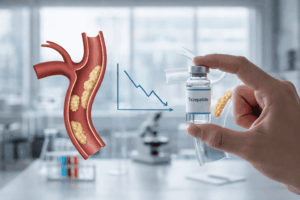
Tirzepatide is used to treat metabolic conditions, but does tirzepatide lower cholesterol? Cholesterol levels have an effect on heart health, insulin resistance, and long-term metabolic well-being. Knowing how this drug changes lipid levels helps patients and doctors make evidence-based choices. At TrimBody M.D, this topic comes up often during health checkups.
The cholesterol shifts tied to tirzepatide are not random or minor. They represent bigger changes in how the body manages insulin, fat metabolism, and inflammation. When these systems get better, cholesterol often improves as well. Speak with a licensed medical provider with us today
Key Takeaways:
- Tirzepatide helps lower LDL cholesterol levels.
- Triglyceride levels tend to drop when weight decreases.
- The changes link to better insulin sensitivity rather than targeting lipids specifically.
- High cholesterol is not a reported side effect.
- Regular medical supervision supports better heart health.
Understanding How Tirzepatide Regulates Cholesterol
Tirzepatide activates both GLP-1 and GIP receptors. These pathways help control insulin release, appetite, and how the liver processes fat. The liver is where cholesterol is produced, and insulin resistance contributes to excess LDL production.
When insulin sensitivity gets better, the liver makes fewer very low-density lipoproteins. These particles turn into LDL cholesterol in the bloodstream. Having less visceral fat also means fewer free fatty acids flow to the liver, which helps reduce cholesterol production.
Studies reveal that cholesterol levels improve as blood sugar control and body composition improve. Tirzepatide is not a cholesterol medication, but it affects certain processes that help manage lipid levels in the body.
Let our team know how we can help with your goals!
Research Backing Cholesterol Improvements
Several studies have looked at cholesterol-related changes during trispeptide use. Results show patients often have lower LDL cholesterol and triglyceride levels compared to their starting points. These benefits happen along with better HbA1c levels and steady weight loss.
Based on clinical trial data, tirzepatide showed major improvements in atherogenic lipid profiles in adults with metabolic diseases. This suggests an added cardiovascular advantage linked with fixing metabolic irregularities instead of lowering lipid levels.
Studies on incretin-based treatments reveal similar drops in inflammatory markers that influence how lipid particles behave. According to metabolic analysis, lowering inflammation helps clear lipids more effectively and promotes better endothelial function. Both are key to reducing heart-related risks.
Does Tirzepatide Cause High Cholesterol?
Patients sometimes worry that appetite changes or releasing fat might lead to higher cholesterol. However, current data does not back this worry. Testing has not shown Tirzepatide to raise LDL cholesterol or triglycerides in clinical research or when used in real-world settings.
Short-term changes in lipids can happen during treatment when calorie consumption changes. These levels balance out over time as the body adjusts. Over longer periods, improvements are more likely than increases.
Patients keeping track of heart health often look at cholesterol numbers alongside other factors like blood pressure and inflammatory markers. Our expert provides more detailed guidance explaining how this ties into the effects on blood pressure.
To discuss our services, contact us today!
Losing Weight and Better Cholesterol Levels
Losing weight plays a big role in improving lipids with tirzepatide treatment. When fat around the organs decreases, the liver gets exposed to fewer fatty acids in the bloodstream. This drop in fatty acids lowers cholesterol production.
Shedding pounds also changes how adipokines signal, which affects how lipids move and are used for energy. Even if HDL levels stay the same, its function can get better. These benefits cut heart risks beyond just lowering cholesterol numbers.
People using tirzepatide injections Irvine under a doctor’s care often see improvements in weight, blood sugar, and cholesterol levels working together.
Need help deciding? Fill out a contact form,and we’ll ensure you’re informed!
Inflammation, Insulin Resistance, and Lipid Health
Chronic inflammation changes how lipids are processed and raises the risk of heart disease even without raising cholesterol levels. Insulin resistance makes this issue worse by reducing the body’s ability to clear lipids.
Tirzepatide lowers the inflammatory signals tied to metabolic problems. When inflammation decreases, lipid particles become less harmful and are cleared from the bloodstream more.
This process shows why cholesterol levels can improve more than expected from weight loss alone. Learn more about how tirzepatide may reduce inflammation.
Who Benefits Most from Cholesterol Levels?
Patients with insulin resistance, higher triglycerides, or metabolic syndrome often notice the biggest changes in their cholesterol levels. People already taking statins might see smaller number changes, but their overall heart health markers can still get better.
Lifestyle choices also play an important role. Eating healthy fats, getting enough fiber, and staying active all affect how lipids respond. Having medical supervision helps make changes that meet cholesterol goals while keeping blood sugar steady.
Keeping Track of Cholesterol While Using Tirzepatide
Doctors typically check baseline lipid panels before beginning treatment. Testing over time shows patterns instead of single changes. This method ensures safe dosage and finds patients who might need extra lipid therapy.
To treat heart disease, tirzepatide works with but does not replace cholesterol-specific medicines. Coordination of care remains important.
How TrimBody M.D. Helps Protect the Heart
TrimBody M.D. uses metabolic monitoring to guide tirzepatide therapies. They study cholesterol trends with glucose levels, inflammation, and patient medical records. This detailed method focuses on long-term heart health through informed treatment choices.
Our patients benefit from:
- Check lipid panel results
- Offer medication advice based on lab patterns
- Work with primary care providers
- Teach patients about metabolic health risks
- Rely on extensive experience with 30,000+ patients
What Patients Should Know About Tirzepatide
So, does tirzepatide lower cholesterol in a clinically relevant way? For a lot of patients, it does. This medicine helps bring about metabolic improvements. It lowers LDL cholesterol and triglycerides and can enhance overall heart health. The results vary based on individual health, how the treatment plan is followed, and proper medical guidance, but it leads to healthier outcomes. Book your free consultation today.
Disclaimer: This article is for informational and educational purposes. Treatment decisions are made during an individual medical evaluation with a licensed provider. We provide compounded tirzepatide and are not affiliated with or endorsed by the manufacturers of Zepbound® or Mounjaro®.
FAQs About Tirzepatide and Cholesterol
Can Tirzepatide Replace Cholesterol Medication
No. Tirzepatide is not prescribed as a cholesterol drug. Some patients still require statins or other lipid medications based on cardiovascular risk, genetics, and prior heart disease history.
How Fast Do Cholesterol Changes Appear
Cholesterol changes are not immediate. Most measurable improvements appear after several months as weight, insulin sensitivity, and liver fat gradually decline.
Does Tirzepatide Affect HDL Cholesterol
HDL cholesterol levels often remain stable. However, HDL function may improve, meaning cholesterol is transported and cleared more efficiently, even without large numerical changes.
Should Cholesterol Be Checked More Often On Tirzepatide
Yes, especially during early treatment. Periodic lipid panels help track trends and identify patients who need additional cardiovascular management alongside metabolic therapy.
Can Diet Override Tirzepatide Cholesterol Benefits
Yes. Diet quality still matters. High saturated fat intake can blunt lipid improvements even when weight and glucose control improve.
Call and talk to a specialist today! (702) 489-3300
Let our team know how we can help with your goals!

Get In Touch With Us
Schedule Your Free Consultation — Take Your First Step Today
 Henderson
Let our team of Medical Professionals help you achieve your body goals. Contact us Today!