
'%3e%3cpath%20d='M12.0979%2019.9987C10.6974%2019.9987%209.29703%2019.4657%208.2309%2018.3995L1.60176%2011.7704C0.568828%2010.7375%200%209.36414%200%207.9034C0%206.44262%200.568828%205.06934%201.6018%204.03641C2.51562%203.12254%204.00258%203.12262%204.91633%204.03637L7.12605%206.2461C8.03988%207.15992%208.03988%208.6468%207.12605%209.56067C6.97848%209.70821%206.89723%209.90442%206.89723%2010.1131C6.89723%2010.3218%206.97848%2010.5179%207.12602%2010.6655L9.33574%2012.8752C9.48328%2013.0228%209.67949%2013.1041%209.88816%2013.1041C10.0969%2013.1041%2010.293%2013.0228%2010.4406%2012.8753C11.3545%2011.9614%2012.8414%2011.9614%2013.7552%2012.8753L15.9649%2015.085C16.8787%2015.9988%2016.8787%2017.4857%2015.9649%2018.3995C14.8987%2019.4657%2013.4983%2019.9987%2012.0979%2019.9987ZM3.25906%204.91281C3.05898%204.91281%202.85895%204.98895%202.7066%205.14129C1.96883%205.87906%201.5625%206.86%201.5625%207.9034C1.5625%208.9468%201.96883%209.92774%202.7066%2010.6655L9.33574%2017.2947C10.8587%2018.8177%2013.337%2018.8177%2014.86%2017.2947C15.1646%2016.99%2015.1646%2016.4944%2014.86%2016.1898L12.6503%2013.9801C12.5028%2013.8325%2012.3066%2013.7513%2012.0979%2013.7513C11.8892%2013.7513%2011.693%2013.8325%2011.5455%2013.98C10.6316%2014.8939%209.14473%2014.8939%208.23086%2013.98L6.02117%2011.7703C5.57852%2011.3277%205.33473%2010.7391%205.33473%2010.113C5.33473%209.48703%205.57852%208.89844%206.02117%208.45578C6.16875%208.30824%206.25%208.11203%206.25%207.90336C6.25%207.69469%206.16875%207.49852%206.02117%207.35094L3.81148%205.14121C3.65918%204.98899%203.4591%204.91281%203.25906%204.91281Z'%20fill='black'/%3e%3cpath%20d='M9.5448%209.3168C9.25285%209.1959%209.0625%208.91102%209.0625%208.59504V0.782539C9.0625%200.351055%209.41227%200.00128937%209.84375%200.00128937H19.2188C19.6502%200.00128937%2020%200.351055%2020%200.782539V7.03254C20%207.46402%2019.6502%207.81379%2019.2188%207.81379H11.7298L10.3962%209.14746C10.1728%209.3709%209.83676%209.43773%209.5448%209.3168ZM10.625%201.56379V6.70895L10.8538%206.48012C11.0003%206.33359%2011.199%206.25129%2011.4062%206.25129H18.4375V1.56379H10.625Z'%20fill='black'/%3e%3cpath%20d='M12.9688%204.68879C13.4002%204.68879%2013.75%204.33901%2013.75%203.90754C13.75%203.47607%2013.4002%203.12629%2012.9688%203.12629C12.5373%203.12629%2012.1875%203.47607%2012.1875%203.90754C12.1875%204.33901%2012.5373%204.68879%2012.9688%204.68879Z'%20fill='black'/%3e%3cpath%20d='M16.0938%204.68879C16.5252%204.68879%2016.875%204.33901%2016.875%203.90754C16.875%203.47607%2016.5252%203.12629%2016.0938%203.12629C15.6623%203.12629%2015.3125%203.47607%2015.3125%203.90754C15.3125%204.33901%2015.6623%204.68879%2016.0938%204.68879Z'%20fill='black'/%3e%3c/g%3e%3cdefs%3e%3cclipPath%20id='clip0_6353_9'%3e%3crect%20width='20'%20height='20'%20fill='white'/%3e%3c/clipPath%3e%3c/defs%3e%3c/svg%3e)
'%3e%3cpath%20d='M10%2020C13.8389%2020%2017.0312%2018.3836%2017.0312%2016.0938C17.0312%2015.4405%2016.7592%2014.8022%2016.2444%2014.2478C15.9508%2013.9316%2015.4565%2013.9132%2015.1403%2014.2068C14.8241%2014.5004%2014.8058%2014.9947%2015.0994%2015.3109C15.3444%2015.5749%2015.4687%2015.8383%2015.4687%2016.0938C15.4687%2017.2001%2013.13%2018.4375%209.99996%2018.4375C6.86996%2018.4375%204.53121%2017.2001%204.53121%2016.0938C4.53121%2015.8382%204.65547%2015.5749%204.90055%2015.3109C5.19414%2014.9947%205.17582%2014.5004%204.85965%2014.2068C4.54348%2013.9133%204.04914%2013.9316%203.75555%2014.2477C3.24082%2014.8021%202.96875%2015.4405%202.96875%2016.0938C2.96875%2018.3803%206.15578%2020%2010%2020Z'%20fill='black'/%3e%3cpath%20d='M8.13172%2015.9465C8.57285%2016.5282%209.27023%2016.875%2010%2016.875C10.7298%2016.875%2011.4271%2016.5282%2011.8683%2015.9466L15.6293%2011.2402C16.5465%2010.0163%2017.0312%208.5609%2017.0312%207.03125C17.0312%203.15422%2013.877%200%2010%200C6.12297%200%202.96875%203.15422%202.96875%207.03125C2.96875%208.56094%203.45352%2010.0164%204.37063%2011.2402L8.13172%2015.9465ZM10%201.5625C13.0155%201.5625%2015.4688%204.01578%2015.4688%207.03125C15.4688%208.21648%2015.0944%209.34434%2014.386%2010.2938C14.386%2010.2938%2010.6309%2014.9924%2010.626%2014.9989C10.4766%2015.1982%2010.2484%2015.3125%2010%2015.3125C9.75156%2015.3125%209.5234%2015.1982%209.37402%2014.9989C9.36914%2014.9923%209.36418%2014.9859%209.3591%2014.9796L5.61395%2010.2937C4.90559%209.34434%204.53125%208.21652%204.53125%207.03125C4.53125%204.01578%206.98453%201.5625%2010%201.5625Z'%20fill='black'/%3e%3cpath%20d='M10%2010.9375C12.1539%2010.9375%2013.9062%209.18516%2013.9062%207.03125C13.9062%204.87734%2012.1539%203.125%2010%203.125C7.84609%203.125%206.09375%204.87734%206.09375%207.03125C6.09375%209.18516%207.84609%2010.9375%2010%2010.9375ZM10%204.6875C11.2923%204.6875%2012.3438%205.73891%2012.3438%207.03125C12.3438%208.32359%2011.2923%209.375%2010%209.375C8.70766%209.375%207.65625%208.32359%207.65625%207.03125C7.65625%205.73891%208.70766%204.6875%2010%204.6875Z'%20fill='black'/%3e%3c/g%3e%3cdefs%3e%3cclipPath%20id='clip0_6353_60'%3e%3crect%20width='20'%20height='20'%20fill='white'/%3e%3c/clipPath%3e%3c/defs%3e%3c/svg%3e)

'%3e%3ccircle%20cx='321'%20cy='321'%20r='276'%20transform='matrix(-1%200%200%201%20481%200)'%20stroke='%23E5DFD3'%20stroke-width='90'/%3e%3c/g%3e%3cdefs%3e%3cclipPath%20id='clip0_6046_3421'%3e%3crect%20width='481'%20height='413'%20fill='white'%20transform='matrix(-1%200%200%201%20481%200)'/%3e%3c/clipPath%3e%3c/defs%3e%3c/svg%3e)
Does Zepbound for Sleep Apnea Actually Work?
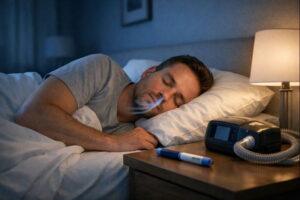
Sleep apnea lowers breathing quality, drains energy, and harms heart health over time. The condition often gets worse with increasing weight. A lot of patients now bring up Zepbound sleep apnea out of interest in new treatment options. At TrimBody M.D, we focus on medical care, weight-loss methods, and science-based advice to tackle this issue.
Learning about Zepbound and sleep apnea allows people to see the link between losing weight and better sleep and breathing at night. Studies confirm that dealing with extra weight can lessen blocked airways while sleeping. Speak with our clinician about sleep apnea support today.
Key Takeaways
- Zepbound focuses on solving weight issues that make obstructive sleep apnea worse.
- Losing weight may help keep the airway steady while sleeping.
- Studies reveal noticeable improvement in apnea with treatment.
- Zepbound is not a replacement for CPAP but might lower the need for it.
- Getting medical advice can increase safety and encourage better long-term results.
How Extra Weight Makes Sleep Apnea Worse
Learning how body weight affects sleep apnea shows why addressing weight is important.
Fat buildup around the neck and throat raises the chance of the airway collapsing during sleep. This collapse stops breathing and causes oxygen levels to dip multiple times during the night. The pressure on airways due to extra weight plays a big part in how severe obstructive sleep apnea gets.
Excess belly fat makes it harder to breathe by restricting lung movement. Smaller lung volume ends up making airways less stable during sleep. Together, these problems make apnea episodes worse and more frequent.
Obesity-related hormonal shifts also weaken the muscles that support the airway. This weak support makes the airway collapse easier. Losing weight can help fix these physical issues at the same time.
Let our team know how we can help with your goals!
How Does Zepbound Help With Sleep Apnea
Zepbound aids sleep apnea improvement by dealing with weight-related problems.
Zepbound helps with long-term weight loss by curbing hunger and boosting metabolism. Losing weight shrinks fat around the upper airway. This shrinking helps keep the airway clear when sleeping.
When body weight goes down, lung capacity gets better, which leads to easier breathing at night. Better breathing lessens apnea episodes and prevents oxygen levels from dropping. These improvements make sleep cycles more refreshing.
Studies also show that improving insulin sensitivity can help lower swelling in airway tissues. Less swelling helps keep airways steadier. Together, these effects shed light on how does zepbound help with sleep apnea over time.
What Studies Reveal About Zepbound and Sleep Apnea
Studies highlight the link between Zepbound and losing weight and better sleep apnea symptoms.
The American Academy of Sleep Medicine explains that clinical trials showed less severe apnea after a year of treatment. Participants had fewer breathing problems compared to those on a placebo. Weight loss was a key factor in these positive results.
A study reviewed by peers and listed on PubMed shows that losing a lot of weight improves airway stability and raises oxygen levels in the blood. These improvements lead to fewer apnea episodes. Researchers highlighted the importance of slow and steady weight loss.
Other studies shared that the FDA’s approval shows increasing proof that metabolic therapies can help improve sleep apnea. Experts stressed the need for medical monitoring to ensure safety. These insights boost confidence in using Zepbound for sleep apnea as part of a thorough care plan.
To discuss our services, contact us today!
How Long Does It Take for Zepbound to Work for Sleep Apnea?
Knowing how long this treatment takes to work helps patients stay patient and stick to it.
Weight loss happens over the first few months. Sleep apnea symptoms tend to improve as people lose weight. Some early changes in symptoms might be noticeable after three to six months.
As people lose weight, airway pressure drops over time. This drop helps reduce how often apnea happens. To see significant results, consistent effort is usually needed.
Doctors monitor sleep quality and changes in symptoms during treatment. They adjust care plans based on the progress. Knowing how long improvements might take helps patients stay committed and feel more confident.
Need help deciding? Fill out a contact form,and we’ll ensure you’re informed!
Can Zepbound Be Prescribed For Sleep Apnea?
People often wonder if Zepbound is given to treat sleep apnea.
Doctors prescribe Zepbound as a weight loss medication, not as a treatment to open airways. Its connection to sleep apnea is through the positive effects of weight loss. Medical professionals look at a patient’s overall health to decide on the right treatment.
In 2024, the FDA approved Zepbound for sleep apnea, marking a significant shift in treatment recognition. This decision highlights that losing weight can be an important way to manage sleep apnea. Doctors still need to decide the right situations to use it.
Zepbound does not take the place of CPAP therapy. It might help lower the severity of sleep apnea or make other treatments work better. Patients often see the best results when combining different treatments.
How Tracking Weight Loss Can Support Better Sleep Apnea Outcomes
Monitoring how much weight one loses allows patients to see if their treatment is working.
Losing appetite earlier helps control calories and shed fat. To set practical goals, people should understand zepbound weight loss expectations. Staying consistent is more important than losing weight.
As people lose weight, their breathing improves bit by bit. Lower airway pressure reduces the chance of blockages happening. These improvements let oxygen flow better.
Doctors check both progress and any symptoms at the same time. Changes in the plan help things work better. Medical advice ensures the treatment stays right for what the patient needs.
How Zepbound Helps Sleep Apnea Patients Best
Weight loss does not solve sleep apnea the same way for everyone.
People with obstructive sleep apnea caused by obesity see the most improvement. Losing weight helps clear airway obstructions in these situations. Still, a person’s unique body anatomy also plays a role.
Patients who use CPAP devices might find it easier to tolerate them if they lose weight. Reducing weight can lower the needed pressure, making the experience more comfortable. Using a combined approach for treatment helps boost patient compliance.
People with central sleep apnea need different kinds of care. Providers look at the type of apnea before deciding on treatments. Accurate diagnosis plays a key role in prescribing treatments.
How Our Clinic Supports Safe Zepbound Use for Managing Sleep Apnea
TrimBody M.D. offers weight loss programs led by doctors aiming to improve both sleep and general health. We assist patients in managing their medication while keeping track of sleep apnea symptoms and their progress. So far, we have helped 30,000+ patients through medical weight loss plans backed by research.
- Doctors provide evaluations and create treatment plans.
- We help track weight loss progress and monitor symptoms.
- Learn about sleep apnea and how it connects to your overall health.
- Get support from our tirzepatide clinic services.
Things To Keep in Mind Before Starting Zepbound Sleep Apnea Treatment
Treating Zepbound Sleep Apnea takes time, proper medical care, and setting realistic goals. Losing weight helps improve breathing and keeps the airways steady in the long run. Working with healthcare providers ensures safe and effective use of the treatment. Book a consultation today to explore personalized treatment options with our team.
Disclaimer: This article is for informational and educational purposes. Treatment decisions are made during an individual medical evaluation with a licensed provider. We provide compounded tirzepatide and are not affiliated with or endorsed by the manufacturers of Zepbound® or Mounjaro®.
FAQs About Zepbound and Sleep Apnea
Can Zepbound Improve Sleep Apnea Symptoms
Yes, Zepbound may reduce sleep apnea severity by supporting weight loss. Lower body weight can decrease airway pressure and breathing interruptions over time.
Is Zepbound A Replacement For CPAP Therapy
No, Zepbound does not replace CPAP for most patients. It may reduce apnea severity and improve CPAP tolerance when used alongside standard therapy.
How Much Weight Loss Is Needed To Help Sleep Apnea
Even modest weight loss can improve obstructive sleep apnea symptoms. Greater and sustained weight reduction often leads to more noticeable breathing improvements.
Who Benefits Most From Zepbound For Sleep Apnea
Patients with obesity-related obstructive sleep apnea benefit most. Outcomes depend on anatomy, apnea severity, and adherence to a supervised weight loss plan.
How Soon Can Sleep Apnea Improve On Zepbound
Some patients notice symptom improvement within three to six months. Meaningful apnea reduction usually follows steady, sustained weight loss over time.
Call and talk to a specialist today! (702) 489-3300
Let our team know how we can help with your goals!

Get In Touch With Us
Schedule Your Free Consultation — Take Your First Step Today
 Henderson
Let our team of Medical Professionals help you achieve your body goals. Contact us Today!