
'%3e%3cpath%20d='M12.0979%2019.9987C10.6974%2019.9987%209.29703%2019.4657%208.2309%2018.3995L1.60176%2011.7704C0.568828%2010.7375%200%209.36414%200%207.9034C0%206.44262%200.568828%205.06934%201.6018%204.03641C2.51562%203.12254%204.00258%203.12262%204.91633%204.03637L7.12605%206.2461C8.03988%207.15992%208.03988%208.6468%207.12605%209.56067C6.97848%209.70821%206.89723%209.90442%206.89723%2010.1131C6.89723%2010.3218%206.97848%2010.5179%207.12602%2010.6655L9.33574%2012.8752C9.48328%2013.0228%209.67949%2013.1041%209.88816%2013.1041C10.0969%2013.1041%2010.293%2013.0228%2010.4406%2012.8753C11.3545%2011.9614%2012.8414%2011.9614%2013.7552%2012.8753L15.9649%2015.085C16.8787%2015.9988%2016.8787%2017.4857%2015.9649%2018.3995C14.8987%2019.4657%2013.4983%2019.9987%2012.0979%2019.9987ZM3.25906%204.91281C3.05898%204.91281%202.85895%204.98895%202.7066%205.14129C1.96883%205.87906%201.5625%206.86%201.5625%207.9034C1.5625%208.9468%201.96883%209.92774%202.7066%2010.6655L9.33574%2017.2947C10.8587%2018.8177%2013.337%2018.8177%2014.86%2017.2947C15.1646%2016.99%2015.1646%2016.4944%2014.86%2016.1898L12.6503%2013.9801C12.5028%2013.8325%2012.3066%2013.7513%2012.0979%2013.7513C11.8892%2013.7513%2011.693%2013.8325%2011.5455%2013.98C10.6316%2014.8939%209.14473%2014.8939%208.23086%2013.98L6.02117%2011.7703C5.57852%2011.3277%205.33473%2010.7391%205.33473%2010.113C5.33473%209.48703%205.57852%208.89844%206.02117%208.45578C6.16875%208.30824%206.25%208.11203%206.25%207.90336C6.25%207.69469%206.16875%207.49852%206.02117%207.35094L3.81148%205.14121C3.65918%204.98899%203.4591%204.91281%203.25906%204.91281Z'%20fill='black'/%3e%3cpath%20d='M9.5448%209.3168C9.25285%209.1959%209.0625%208.91102%209.0625%208.59504V0.782539C9.0625%200.351055%209.41227%200.00128937%209.84375%200.00128937H19.2188C19.6502%200.00128937%2020%200.351055%2020%200.782539V7.03254C20%207.46402%2019.6502%207.81379%2019.2188%207.81379H11.7298L10.3962%209.14746C10.1728%209.3709%209.83676%209.43773%209.5448%209.3168ZM10.625%201.56379V6.70895L10.8538%206.48012C11.0003%206.33359%2011.199%206.25129%2011.4062%206.25129H18.4375V1.56379H10.625Z'%20fill='black'/%3e%3cpath%20d='M12.9688%204.68879C13.4002%204.68879%2013.75%204.33901%2013.75%203.90754C13.75%203.47607%2013.4002%203.12629%2012.9688%203.12629C12.5373%203.12629%2012.1875%203.47607%2012.1875%203.90754C12.1875%204.33901%2012.5373%204.68879%2012.9688%204.68879Z'%20fill='black'/%3e%3cpath%20d='M16.0938%204.68879C16.5252%204.68879%2016.875%204.33901%2016.875%203.90754C16.875%203.47607%2016.5252%203.12629%2016.0938%203.12629C15.6623%203.12629%2015.3125%203.47607%2015.3125%203.90754C15.3125%204.33901%2015.6623%204.68879%2016.0938%204.68879Z'%20fill='black'/%3e%3c/g%3e%3cdefs%3e%3cclipPath%20id='clip0_6353_9'%3e%3crect%20width='20'%20height='20'%20fill='white'/%3e%3c/clipPath%3e%3c/defs%3e%3c/svg%3e)
'%3e%3cpath%20d='M10%2020C13.8389%2020%2017.0312%2018.3836%2017.0312%2016.0938C17.0312%2015.4405%2016.7592%2014.8022%2016.2444%2014.2478C15.9508%2013.9316%2015.4565%2013.9132%2015.1403%2014.2068C14.8241%2014.5004%2014.8058%2014.9947%2015.0994%2015.3109C15.3444%2015.5749%2015.4687%2015.8383%2015.4687%2016.0938C15.4687%2017.2001%2013.13%2018.4375%209.99996%2018.4375C6.86996%2018.4375%204.53121%2017.2001%204.53121%2016.0938C4.53121%2015.8382%204.65547%2015.5749%204.90055%2015.3109C5.19414%2014.9947%205.17582%2014.5004%204.85965%2014.2068C4.54348%2013.9133%204.04914%2013.9316%203.75555%2014.2477C3.24082%2014.8021%202.96875%2015.4405%202.96875%2016.0938C2.96875%2018.3803%206.15578%2020%2010%2020Z'%20fill='black'/%3e%3cpath%20d='M8.13172%2015.9465C8.57285%2016.5282%209.27023%2016.875%2010%2016.875C10.7298%2016.875%2011.4271%2016.5282%2011.8683%2015.9466L15.6293%2011.2402C16.5465%2010.0163%2017.0312%208.5609%2017.0312%207.03125C17.0312%203.15422%2013.877%200%2010%200C6.12297%200%202.96875%203.15422%202.96875%207.03125C2.96875%208.56094%203.45352%2010.0164%204.37063%2011.2402L8.13172%2015.9465ZM10%201.5625C13.0155%201.5625%2015.4688%204.01578%2015.4688%207.03125C15.4688%208.21648%2015.0944%209.34434%2014.386%2010.2938C14.386%2010.2938%2010.6309%2014.9924%2010.626%2014.9989C10.4766%2015.1982%2010.2484%2015.3125%2010%2015.3125C9.75156%2015.3125%209.5234%2015.1982%209.37402%2014.9989C9.36914%2014.9923%209.36418%2014.9859%209.3591%2014.9796L5.61395%2010.2937C4.90559%209.34434%204.53125%208.21652%204.53125%207.03125C4.53125%204.01578%206.98453%201.5625%2010%201.5625Z'%20fill='black'/%3e%3cpath%20d='M10%2010.9375C12.1539%2010.9375%2013.9062%209.18516%2013.9062%207.03125C13.9062%204.87734%2012.1539%203.125%2010%203.125C7.84609%203.125%206.09375%204.87734%206.09375%207.03125C6.09375%209.18516%207.84609%2010.9375%2010%2010.9375ZM10%204.6875C11.2923%204.6875%2012.3438%205.73891%2012.3438%207.03125C12.3438%208.32359%2011.2923%209.375%2010%209.375C8.70766%209.375%207.65625%208.32359%207.65625%207.03125C7.65625%205.73891%208.70766%204.6875%2010%204.6875Z'%20fill='black'/%3e%3c/g%3e%3cdefs%3e%3cclipPath%20id='clip0_6353_60'%3e%3crect%20width='20'%20height='20'%20fill='white'/%3e%3c/clipPath%3e%3c/defs%3e%3c/svg%3e)

'%3e%3ccircle%20cx='321'%20cy='321'%20r='276'%20transform='matrix(-1%200%200%201%20481%200)'%20stroke='%23E5DFD3'%20stroke-width='90'/%3e%3c/g%3e%3cdefs%3e%3cclipPath%20id='clip0_6046_3421'%3e%3crect%20width='481'%20height='413'%20fill='white'%20transform='matrix(-1%200%200%201%20481%200)'/%3e%3c/clipPath%3e%3c/defs%3e%3c/svg%3e)
How Much Protein Should I Eat on Zepbound?
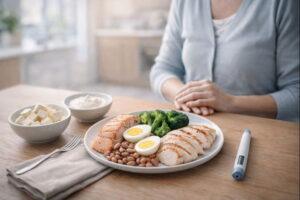
How much protein should I eat on Zepbound? Knowing how protein needs change, how low appetite affects intake, and how proper nutrition supports muscle health can help patients stay strong and progress safely during treatment. At TrimBody M.D., clinicians monitor protein intake closely to protect lean mass and support sustainable weight loss. Review your nutrition plan with our team today. Schedule a free consultation for personalized nutrition guidance.
Key Takeaways:
- Protein needs increase during rapid weight loss
- Low appetite raises the risk of muscle loss
- Daily targets depend on body weight and goals
- Protein timing matters as much as total intake
- Medical guidance helps prevent deficiencies
How Much Protein Should I Have Daily While on Zepbound?
People taking Zepbound do better with more protein than typical diet suggestions recommend. Doctors often advise aiming for 0.6 to 0.8 grams of protein per pound of your ideal body weight. This amount may change based on how active you are or your health needs.
For most, this means eating 90 to 130 grams of protein each day. Smaller people might need less, while taller or more active individuals might require more protein.
Eating protein throughout the day is important. Having protein spread across meals helps the body build muscle better than eating most of it in one sitting. People who miss meals often find it hard to catch up on their protein goals later.
Drinking protein-based liquids can assist during the early stages of treatment when it’s harder to handle solid food. Over time, as eating normalizes, getting protein from whole foods becomes more manageable.
Planning for solid protein intake is a must while aiming to lose weight. Without a proper nutrition plan many people who focus on shedding pounds end up losing muscle along with fat.
Let our team know how we can help with your goals!
How Protein Needs Shift on Zepbound
Zepbound lowers appetite and slows digestion. It helps people eat less, but it raises the chances of not eating enough protein. When calorie levels drop too fast, the body might use muscle tissue if it does not get enough protein.
Protein plays a big role in keeping lean muscle, supporting metabolism, boosting immunity, and aiding recovery. While losing weight, keeping muscle helps retain strength and avoid slowing down metabolism. Losing muscle makes it harder to keep weight off and increases the chance of gaining it back over time.
Research on GLP-1 and similar therapies shows that missing out on protein is a major cause of losing muscle that people want to keep. Just lowering appetite does not protect muscle mass. Eating with purpose is essential.
Knowing when appetite suppression happens helps patients eat protein earlier in the day, before feeling full makes it hard to consume enough.
What Happens If You Don’t Get Enough Protein on Zepbound?
Not eating enough protein during treatment creates several clear issues. The biggest problem is muscle loss, which weakens the body, slows metabolism, and makes maintaining a healthy weight tough in the long run.
Low protein intake can lead to tiredness, thinning hair, slow healing, and feeling hungrier between meals. These signs often develop, making them easy to miss.
Research by Sword Health explains that losing muscle during GLP-1–based weight loss happens more because of low protein consumption than the medication itself. Keeping muscles strong means eating enough protein during treatment.
In the long run, low protein can lower your metabolism and increase the chances of gaining weight again after stopping the medication. This makes planning your protein intake a must, not something optional.
To discuss our services, contact us today!
Focusing on Protein Timing, Quality, and Absorption with Zepbound
When using Zepbound, meal timing becomes important since appetite suppression reduces how much you eat. Eating protein first during meals helps you hit your nutrition goals before you feel full.
Good protein comes from lean meats, eggs, fish, dairy, and plant proteins that have all essential amino acids. The body needs these to help keep muscles healthy.
In the early stages of treatment, digestion might slow, which can change how the body absorbs nutrients. Eating smaller meals with more protein often helps compared to big servings.
Protein powders might help for a short time, but it’s better to focus on real food in the long run. Doctors can offer advice to make eating easier and still cover all nutritional needs.
Need help deciding? Fill out a contact form,and we’ll ensure you’re informed!
How We Help With Protein on Zepbound
TrimBody M.D. focuses on protein intake as a foundation of medical weight loss, not a secondary concern. We give patients tailored advice that considers their body composition, metabolic health, and progress during treatment. With over 30,000 patients served, nutrition planning remains part of every step.
- Custom daily protein goals aligned with body composition
- Plans for managing low appetite and the early phases of treatment
- Tracking muscle loss, energy levels, and missing nutrients
- Advice about when to eat protein and what foods to choose
- Aligning diet plans with weight loss objectives and lab findings
Patients who join a structured medical weight loss program benefit from regular checkups and adjustments as their treatment evolves.
Easy Protein Advice for People Taking Zepbound
Meeting protein goals does not require complicated plans. Simple, repeatable habits support consistency and reduce overwhelm, including:
- Prioritizing protein at every meal, even small portions, to protect lean mass during appetite suppression.
- Starting the day with protein to help offset reduced intake later when fullness increases.
- Keeping convenient protein options available to prevent skipped meals during low appetite periods.
- Using smaller, protein-focused meals if larger portions feel uncomfortable early in treatment.
- Addressing difficulty meeting protein targets early, since delays often lead to fatigue and stalled progress.
How to Set Your Protein Goal While on Zepbound
Deciding how much protein should I eat on Zepbound depends on your body type, weight loss plans, and your doctor’s guidance. Eating more protein helps protect your muscles, maintain metabolism, and improve long-term outcomes. People who plan their protein intake tend to see safer and steadier progress.
Schedule a free consultation today to discuss protein requirements and create a weight loss plan with medical advice.
Disclaimer: This article is for informational and educational purposes. Treatment decisions are made during an individual medical evaluation with a licensed provider. We provide compounded tirzepatide and are not affiliated with or endorsed by the manufacturers of Zepbound® or Mounjaro®.
FAQs about Protein Intake on Zepbound
Should Protein Intake Increase When Starting Zepbound?
Yes. Reduced appetite can lower overall intake, so higher protein density helps protect lean mass during weight loss. Most patients need to prioritize protein earlier in the day to meet daily targets.
Can Low Protein Intake Slow Weight Loss Progress?
It can. Inadequate protein may contribute to muscle loss and fatigue, which can reduce metabolic rate and stall fat loss over time.
Are Protein Shakes Necessary While Using Zepbound?
Not always. Whole food protein works well, but shakes can help during early treatment when appetite or meal tolerance is limited.
Does Protein Timing Matter More Than Total Intake?
Both matter. Hitting daily targets is essential, but spreading protein across meals improves muscle support and satiety during calorie restriction.
Can Too Much Protein Cause Problems On Zepbound?
Excessive protein may strain digestion for some patients. Intake should align with body size, kidney health, and medical guidance rather than extreme targets.
Call and talk to a specialist today! (702) 489-3300
Let our team know how we can help with your goals!

Get In Touch With Us
Schedule Your Free Consultation — Take Your First Step Today
 Henderson
Let our team of Medical Professionals help you achieve your body goals. Contact us Today!