
'%3e%3cpath%20d='M12.0979%2019.9987C10.6974%2019.9987%209.29703%2019.4657%208.2309%2018.3995L1.60176%2011.7704C0.568828%2010.7375%200%209.36414%200%207.9034C0%206.44262%200.568828%205.06934%201.6018%204.03641C2.51562%203.12254%204.00258%203.12262%204.91633%204.03637L7.12605%206.2461C8.03988%207.15992%208.03988%208.6468%207.12605%209.56067C6.97848%209.70821%206.89723%209.90442%206.89723%2010.1131C6.89723%2010.3218%206.97848%2010.5179%207.12602%2010.6655L9.33574%2012.8752C9.48328%2013.0228%209.67949%2013.1041%209.88816%2013.1041C10.0969%2013.1041%2010.293%2013.0228%2010.4406%2012.8753C11.3545%2011.9614%2012.8414%2011.9614%2013.7552%2012.8753L15.9649%2015.085C16.8787%2015.9988%2016.8787%2017.4857%2015.9649%2018.3995C14.8987%2019.4657%2013.4983%2019.9987%2012.0979%2019.9987ZM3.25906%204.91281C3.05898%204.91281%202.85895%204.98895%202.7066%205.14129C1.96883%205.87906%201.5625%206.86%201.5625%207.9034C1.5625%208.9468%201.96883%209.92774%202.7066%2010.6655L9.33574%2017.2947C10.8587%2018.8177%2013.337%2018.8177%2014.86%2017.2947C15.1646%2016.99%2015.1646%2016.4944%2014.86%2016.1898L12.6503%2013.9801C12.5028%2013.8325%2012.3066%2013.7513%2012.0979%2013.7513C11.8892%2013.7513%2011.693%2013.8325%2011.5455%2013.98C10.6316%2014.8939%209.14473%2014.8939%208.23086%2013.98L6.02117%2011.7703C5.57852%2011.3277%205.33473%2010.7391%205.33473%2010.113C5.33473%209.48703%205.57852%208.89844%206.02117%208.45578C6.16875%208.30824%206.25%208.11203%206.25%207.90336C6.25%207.69469%206.16875%207.49852%206.02117%207.35094L3.81148%205.14121C3.65918%204.98899%203.4591%204.91281%203.25906%204.91281Z'%20fill='black'/%3e%3cpath%20d='M9.5448%209.3168C9.25285%209.1959%209.0625%208.91102%209.0625%208.59504V0.782539C9.0625%200.351055%209.41227%200.00128937%209.84375%200.00128937H19.2188C19.6502%200.00128937%2020%200.351055%2020%200.782539V7.03254C20%207.46402%2019.6502%207.81379%2019.2188%207.81379H11.7298L10.3962%209.14746C10.1728%209.3709%209.83676%209.43773%209.5448%209.3168ZM10.625%201.56379V6.70895L10.8538%206.48012C11.0003%206.33359%2011.199%206.25129%2011.4062%206.25129H18.4375V1.56379H10.625Z'%20fill='black'/%3e%3cpath%20d='M12.9688%204.68879C13.4002%204.68879%2013.75%204.33901%2013.75%203.90754C13.75%203.47607%2013.4002%203.12629%2012.9688%203.12629C12.5373%203.12629%2012.1875%203.47607%2012.1875%203.90754C12.1875%204.33901%2012.5373%204.68879%2012.9688%204.68879Z'%20fill='black'/%3e%3cpath%20d='M16.0938%204.68879C16.5252%204.68879%2016.875%204.33901%2016.875%203.90754C16.875%203.47607%2016.5252%203.12629%2016.0938%203.12629C15.6623%203.12629%2015.3125%203.47607%2015.3125%203.90754C15.3125%204.33901%2015.6623%204.68879%2016.0938%204.68879Z'%20fill='black'/%3e%3c/g%3e%3cdefs%3e%3cclipPath%20id='clip0_6353_9'%3e%3crect%20width='20'%20height='20'%20fill='white'/%3e%3c/clipPath%3e%3c/defs%3e%3c/svg%3e)
'%3e%3cpath%20d='M10%2020C13.8389%2020%2017.0312%2018.3836%2017.0312%2016.0938C17.0312%2015.4405%2016.7592%2014.8022%2016.2444%2014.2478C15.9508%2013.9316%2015.4565%2013.9132%2015.1403%2014.2068C14.8241%2014.5004%2014.8058%2014.9947%2015.0994%2015.3109C15.3444%2015.5749%2015.4687%2015.8383%2015.4687%2016.0938C15.4687%2017.2001%2013.13%2018.4375%209.99996%2018.4375C6.86996%2018.4375%204.53121%2017.2001%204.53121%2016.0938C4.53121%2015.8382%204.65547%2015.5749%204.90055%2015.3109C5.19414%2014.9947%205.17582%2014.5004%204.85965%2014.2068C4.54348%2013.9133%204.04914%2013.9316%203.75555%2014.2477C3.24082%2014.8021%202.96875%2015.4405%202.96875%2016.0938C2.96875%2018.3803%206.15578%2020%2010%2020Z'%20fill='black'/%3e%3cpath%20d='M8.13172%2015.9465C8.57285%2016.5282%209.27023%2016.875%2010%2016.875C10.7298%2016.875%2011.4271%2016.5282%2011.8683%2015.9466L15.6293%2011.2402C16.5465%2010.0163%2017.0312%208.5609%2017.0312%207.03125C17.0312%203.15422%2013.877%200%2010%200C6.12297%200%202.96875%203.15422%202.96875%207.03125C2.96875%208.56094%203.45352%2010.0164%204.37063%2011.2402L8.13172%2015.9465ZM10%201.5625C13.0155%201.5625%2015.4688%204.01578%2015.4688%207.03125C15.4688%208.21648%2015.0944%209.34434%2014.386%2010.2938C14.386%2010.2938%2010.6309%2014.9924%2010.626%2014.9989C10.4766%2015.1982%2010.2484%2015.3125%2010%2015.3125C9.75156%2015.3125%209.5234%2015.1982%209.37402%2014.9989C9.36914%2014.9923%209.36418%2014.9859%209.3591%2014.9796L5.61395%2010.2937C4.90559%209.34434%204.53125%208.21652%204.53125%207.03125C4.53125%204.01578%206.98453%201.5625%2010%201.5625Z'%20fill='black'/%3e%3cpath%20d='M10%2010.9375C12.1539%2010.9375%2013.9062%209.18516%2013.9062%207.03125C13.9062%204.87734%2012.1539%203.125%2010%203.125C7.84609%203.125%206.09375%204.87734%206.09375%207.03125C6.09375%209.18516%207.84609%2010.9375%2010%2010.9375ZM10%204.6875C11.2923%204.6875%2012.3438%205.73891%2012.3438%207.03125C12.3438%208.32359%2011.2923%209.375%2010%209.375C8.70766%209.375%207.65625%208.32359%207.65625%207.03125C7.65625%205.73891%208.70766%204.6875%2010%204.6875Z'%20fill='black'/%3e%3c/g%3e%3cdefs%3e%3cclipPath%20id='clip0_6353_60'%3e%3crect%20width='20'%20height='20'%20fill='white'/%3e%3c/clipPath%3e%3c/defs%3e%3c/svg%3e)

'%3e%3ccircle%20cx='321'%20cy='321'%20r='276'%20transform='matrix(-1%200%200%201%20481%200)'%20stroke='%23E5DFD3'%20stroke-width='90'/%3e%3c/g%3e%3cdefs%3e%3cclipPath%20id='clip0_6046_3421'%3e%3crect%20width='481'%20height='413'%20fill='white'%20transform='matrix(-1%200%200%201%20481%200)'/%3e%3c/clipPath%3e%3c/defs%3e%3c/svg%3e)
Does Mounjaro Cause Insomnia?
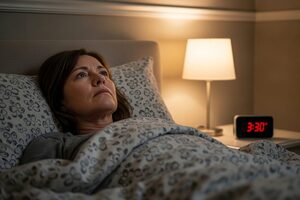
Does Mounjaro cause insomnia? Not directly. While insomnia is not listed as a common side effect of Mounjaro (tirzepatide), some people report trouble falling asleep or staying asleep after starting treatment.
Sleep disturbances are usually linked to nausea, acid reflux, low blood sugar, or eating too little rather than the medication itself. At Trim Body M.D., we help patients identify the cause of sleep changes while continuing physician-supervised weight loss.
Key Takeaways:
- Insomnia is not a common side effect of Mounjaro.
- Digestive symptoms may indirectly interrupt normal sleep.
- Low blood sugar and reduced calorie intake can contribute to restless nights.
- Sleep problems are more common after starting treatment or increasing the dose.
- Most patients notice improvement as their body adjusts.
| Quick Answer | Details |
|---|---|
| Does Mounjaro cause insomnia? | Not directly, but some patients experience sleep disturbances. |
| Why can sleep change? | Nausea, reflux, hypoglycemia, or reduced calorie intake. |
| When is it most common? | During the first weeks or after dose increases. |
| Does it improve? | Yes, for many patients within several weeks. |
| When should you seek medical advice? | Persistent insomnia or symptoms affecting daily life. |
Can Mounjaro Keep You Awake?
Yes, it can for some people, although the medication itself is not considered a stimulant. Instead, Mounjaro may create conditions that make restful sleep more difficult, particularly during the adjustment period.
Many patients notice interrupted sleep after developing nighttime nausea, heartburn, stomach discomfort, or fluctuations in blood sugar. These symptoms may wake you repeatedly or make it difficult to fall asleep after your weekly injection.
If you’re just beginning treatment, our overview of tirzepatide injections explains how your body typically adapts during the first several weeks.
According to the American Academy of Sleep Medicine, growing use of GLP-1 and GIP medications has increased interest in how digestive side effects and weight loss may influence sleep quality over time.
Why Can Mounjaro Affect Your Sleep?
Most sleep problems happen because Mounjaro changes digestion, appetite, and metabolism rather than directly affecting the brain.
Common contributors include:
Gastrointestinal discomfort
Nausea, acid reflux, bloating, or indigestion often become more noticeable after lying down, making it harder to stay asleep.
Low blood sugar
Patients taking insulin or certain diabetes medications alongside Mounjaro may experience overnight hypoglycemia, which can trigger sweating, restlessness, or nighttime awakenings.
Eating too little
Strong appetite suppression sometimes leads patients to skip meals entirely. This can leave the body without enough energy overnight, contributing to hunger, blood sugar fluctuations, and disrupted sleep.
Lifestyle adjustments
Rapid weight loss, changing meal schedules, and adapting to a new medication can temporarily affect normal sleep routines.
If daytime exhaustion accompanies poor sleep, our guide discussing whether tirzepatide makes you tired explains how fatigue and sleep changes may occur together during treatment.
Patients experiencing several digestive symptoms at once may also benefit from learning about the most common tirzepatide side effects, since gastrointestinal symptoms frequently overlap during the first month of therapy.
How to Combat Insomnia on Mounjaro?
Most people can improve sleep without stopping Mounjaro. The goal is to reduce the symptoms that are keeping you awake while allowing your body time to adapt to treatment.
Helpful strategies include:
- Eat balanced meals instead of skipping dinner.
- Avoid heavy or spicy foods close to bedtime if reflux is present.
- Stay hydrated throughout the day.
- Monitor blood sugar if you also use diabetes medications.
- Keep a consistent bedtime routine and limit caffeine later in the day.
If sleep problems continue beyond the normal adjustment period, our guide explaining how long tirzepatide side effects last discusses when symptoms typically improve and when it’s time to contact your healthcare provider.
According to a peer-reviewed study published in the National Library of Medicine, sleep disturbances reported with GLP-1 medications are often linked to secondary symptoms rather than a direct effect on the central nervous system.
How Does Trim Body M.D. Help You Stay Comfortable During Tirzepatide Treatment?
Successful medical weight loss involves more than prescribing medication. At Trim Body M.D., our providers work closely with patients to manage side effects, adjust treatment when appropriate, and provide nutrition and lifestyle guidance that supports long-term success. More than 30,000+ patients have trusted our physician-supervised programs to lose weight safely while staying comfortable throughout treatment.
Patients benefit from:
- Physician-supervised tirzepatide treatment
- Individual dose adjustments
- Side effect monitoring
- Nutrition and hydration guidance
- Ongoing medical follow-up
Frequently Asked Questions
Can Mounjaro Cause Insomnia Every Night?
Usually not. Sleep disturbances are often temporary and tend to improve as your body adjusts to the medication or after digestive symptoms become less noticeable.
Is It Better to Take Mounjaro in The Morning If I Cannot Sleep?
Some patients prefer morning injections if they notice nighttime discomfort, but there is no evidence that changing the injection time alone prevents insomnia. Speak with your healthcare provider before changing your routine.
Can Eating Too Little on Mounjaro Affect Sleep?
Yes. A significant calorie deficit may contribute to nighttime hunger or blood sugar fluctuations, making it harder to stay asleep.
Should I Stop Taking Mounjaro Because of Insomnia?
Not necessarily. Mild sleep disturbances often improve within several weeks. Persistent insomnia or symptoms that interfere with daily activities should be discussed with your healthcare provider.
Can Nausea And Acid Reflux From Mounjaro Keep Me Awake?
Yes. Nighttime nausea, heartburn, and indigestion are among the most common reasons patients experience interrupted sleep while taking Mounjaro.
What Should You Remember About Mounjaro and Sleep?
Does Mounjaro cause insomnia? Not directly, but some patients experience temporary sleep disturbances caused by nausea, acid reflux, blood sugar changes, or reduced calorie intake. Most symptoms improve as the body adapts, especially with proper hydration, balanced nutrition, and physician-guided care.
Ready to start medically supervised weight loss? Contact Trim Body M.D. today.
Disclaimer: This article is for informational and educational purposes. Treatment decisions are made during an individual medical evaluation with a licensed provider. We provide compounded tirzepatide and are not affiliated with or endorsed by the manufacturers of Zepbound® or Mounjaro®.
Let our team know how we can help with your goals!

Get In Touch With Us
Schedule Your Free Consultation — Take Your First Step Today
 Henderson
Let our team of Medical Professionals help you achieve your body goals. Contact us Today!