
'%3e%3cpath%20d='M12.0979%2019.9987C10.6974%2019.9987%209.29703%2019.4657%208.2309%2018.3995L1.60176%2011.7704C0.568828%2010.7375%200%209.36414%200%207.9034C0%206.44262%200.568828%205.06934%201.6018%204.03641C2.51562%203.12254%204.00258%203.12262%204.91633%204.03637L7.12605%206.2461C8.03988%207.15992%208.03988%208.6468%207.12605%209.56067C6.97848%209.70821%206.89723%209.90442%206.89723%2010.1131C6.89723%2010.3218%206.97848%2010.5179%207.12602%2010.6655L9.33574%2012.8752C9.48328%2013.0228%209.67949%2013.1041%209.88816%2013.1041C10.0969%2013.1041%2010.293%2013.0228%2010.4406%2012.8753C11.3545%2011.9614%2012.8414%2011.9614%2013.7552%2012.8753L15.9649%2015.085C16.8787%2015.9988%2016.8787%2017.4857%2015.9649%2018.3995C14.8987%2019.4657%2013.4983%2019.9987%2012.0979%2019.9987ZM3.25906%204.91281C3.05898%204.91281%202.85895%204.98895%202.7066%205.14129C1.96883%205.87906%201.5625%206.86%201.5625%207.9034C1.5625%208.9468%201.96883%209.92774%202.7066%2010.6655L9.33574%2017.2947C10.8587%2018.8177%2013.337%2018.8177%2014.86%2017.2947C15.1646%2016.99%2015.1646%2016.4944%2014.86%2016.1898L12.6503%2013.9801C12.5028%2013.8325%2012.3066%2013.7513%2012.0979%2013.7513C11.8892%2013.7513%2011.693%2013.8325%2011.5455%2013.98C10.6316%2014.8939%209.14473%2014.8939%208.23086%2013.98L6.02117%2011.7703C5.57852%2011.3277%205.33473%2010.7391%205.33473%2010.113C5.33473%209.48703%205.57852%208.89844%206.02117%208.45578C6.16875%208.30824%206.25%208.11203%206.25%207.90336C6.25%207.69469%206.16875%207.49852%206.02117%207.35094L3.81148%205.14121C3.65918%204.98899%203.4591%204.91281%203.25906%204.91281Z'%20fill='black'/%3e%3cpath%20d='M9.5448%209.3168C9.25285%209.1959%209.0625%208.91102%209.0625%208.59504V0.782539C9.0625%200.351055%209.41227%200.00128937%209.84375%200.00128937H19.2188C19.6502%200.00128937%2020%200.351055%2020%200.782539V7.03254C20%207.46402%2019.6502%207.81379%2019.2188%207.81379H11.7298L10.3962%209.14746C10.1728%209.3709%209.83676%209.43773%209.5448%209.3168ZM10.625%201.56379V6.70895L10.8538%206.48012C11.0003%206.33359%2011.199%206.25129%2011.4062%206.25129H18.4375V1.56379H10.625Z'%20fill='black'/%3e%3cpath%20d='M12.9688%204.68879C13.4002%204.68879%2013.75%204.33901%2013.75%203.90754C13.75%203.47607%2013.4002%203.12629%2012.9688%203.12629C12.5373%203.12629%2012.1875%203.47607%2012.1875%203.90754C12.1875%204.33901%2012.5373%204.68879%2012.9688%204.68879Z'%20fill='black'/%3e%3cpath%20d='M16.0938%204.68879C16.5252%204.68879%2016.875%204.33901%2016.875%203.90754C16.875%203.47607%2016.5252%203.12629%2016.0938%203.12629C15.6623%203.12629%2015.3125%203.47607%2015.3125%203.90754C15.3125%204.33901%2015.6623%204.68879%2016.0938%204.68879Z'%20fill='black'/%3e%3c/g%3e%3cdefs%3e%3cclipPath%20id='clip0_6353_9'%3e%3crect%20width='20'%20height='20'%20fill='white'/%3e%3c/clipPath%3e%3c/defs%3e%3c/svg%3e)
'%3e%3cpath%20d='M10%2020C13.8389%2020%2017.0312%2018.3836%2017.0312%2016.0938C17.0312%2015.4405%2016.7592%2014.8022%2016.2444%2014.2478C15.9508%2013.9316%2015.4565%2013.9132%2015.1403%2014.2068C14.8241%2014.5004%2014.8058%2014.9947%2015.0994%2015.3109C15.3444%2015.5749%2015.4687%2015.8383%2015.4687%2016.0938C15.4687%2017.2001%2013.13%2018.4375%209.99996%2018.4375C6.86996%2018.4375%204.53121%2017.2001%204.53121%2016.0938C4.53121%2015.8382%204.65547%2015.5749%204.90055%2015.3109C5.19414%2014.9947%205.17582%2014.5004%204.85965%2014.2068C4.54348%2013.9133%204.04914%2013.9316%203.75555%2014.2477C3.24082%2014.8021%202.96875%2015.4405%202.96875%2016.0938C2.96875%2018.3803%206.15578%2020%2010%2020Z'%20fill='black'/%3e%3cpath%20d='M8.13172%2015.9465C8.57285%2016.5282%209.27023%2016.875%2010%2016.875C10.7298%2016.875%2011.4271%2016.5282%2011.8683%2015.9466L15.6293%2011.2402C16.5465%2010.0163%2017.0312%208.5609%2017.0312%207.03125C17.0312%203.15422%2013.877%200%2010%200C6.12297%200%202.96875%203.15422%202.96875%207.03125C2.96875%208.56094%203.45352%2010.0164%204.37063%2011.2402L8.13172%2015.9465ZM10%201.5625C13.0155%201.5625%2015.4688%204.01578%2015.4688%207.03125C15.4688%208.21648%2015.0944%209.34434%2014.386%2010.2938C14.386%2010.2938%2010.6309%2014.9924%2010.626%2014.9989C10.4766%2015.1982%2010.2484%2015.3125%2010%2015.3125C9.75156%2015.3125%209.5234%2015.1982%209.37402%2014.9989C9.36914%2014.9923%209.36418%2014.9859%209.3591%2014.9796L5.61395%2010.2937C4.90559%209.34434%204.53125%208.21652%204.53125%207.03125C4.53125%204.01578%206.98453%201.5625%2010%201.5625Z'%20fill='black'/%3e%3cpath%20d='M10%2010.9375C12.1539%2010.9375%2013.9062%209.18516%2013.9062%207.03125C13.9062%204.87734%2012.1539%203.125%2010%203.125C7.84609%203.125%206.09375%204.87734%206.09375%207.03125C6.09375%209.18516%207.84609%2010.9375%2010%2010.9375ZM10%204.6875C11.2923%204.6875%2012.3438%205.73891%2012.3438%207.03125C12.3438%208.32359%2011.2923%209.375%2010%209.375C8.70766%209.375%207.65625%208.32359%207.65625%207.03125C7.65625%205.73891%208.70766%204.6875%2010%204.6875Z'%20fill='black'/%3e%3c/g%3e%3cdefs%3e%3cclipPath%20id='clip0_6353_60'%3e%3crect%20width='20'%20height='20'%20fill='white'/%3e%3c/clipPath%3e%3c/defs%3e%3c/svg%3e)
'%3e%3ccircle%20cx='321'%20cy='321'%20r='276'%20transform='matrix(-1%200%200%201%20481%200)'%20stroke='%23E5DFD3'%20stroke-width='90'/%3e%3c/g%3e%3cdefs%3e%3cclipPath%20id='clip0_6046_3421'%3e%3crect%20width='481'%20height='413'%20fill='white'%20transform='matrix(-1%200%200%201%20481%200)'/%3e%3c/clipPath%3e%3c/defs%3e%3c/svg%3e)


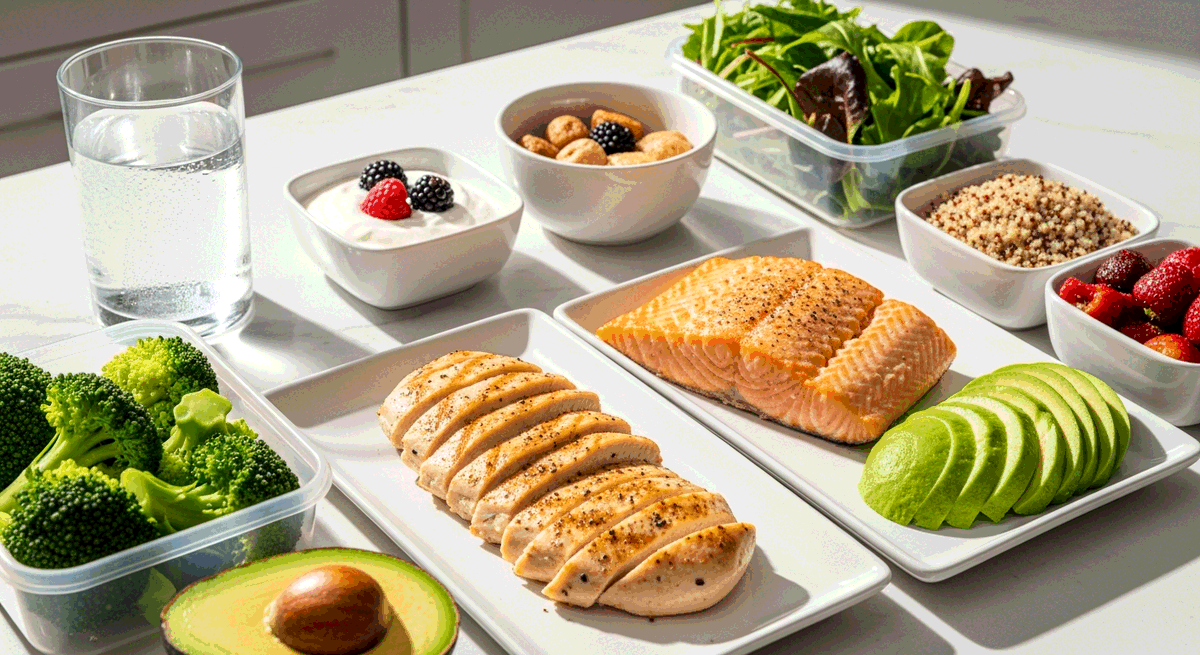
The best diet while on GLP-1 is a protein-focused, high-fiber eating plan that emphasizes whole foods, healthy fats, hydration, and smaller meals. For patients using GLP-1 medications in Costa Mesa, this approach may support weight loss, preserve muscle mass, and reduce digestive side effects in 2026.
At TrimBody M.D., patients receive medical guidance and nutrition support designed to help maximize GLP-1 results safely and sustainably. Start building healthier habits with medical support.
Key Takeaways:
- Eat protein first at every meal.
- Aim for 20-30g protein per meal.
- Prioritize fiber-rich whole foods daily.
- Avoid fried and heavily processed foods.
- Hydration supports digestion and weight loss.
What’s the Best Diet When Taking GLP-1?
The best diet on GLP-1 focuses on whole foods like lean protein, fiber-rich carbs, fruits, veggies, and healthy fats.
Since GLP-1 meds slow how quickly your stomach empties and decrease appetite, meals should give your body the best nutrients possible. These medications often make people eat less, so it’s even more important to choose high-quality food.
| Nutrition Priority | Recommended Target |
|---|---|
| Protein | 20-30g per meal |
| Fiber | 21-30g daily |
| Water | 8-12 cups daily |
| Meals | 4-5 smaller meals |
| Healthy Fats | Moderate portions daily |
Patients going to a Costa Mesa medical weight loss clinic often see good results by pairing medications with well-structured eating plans. Check out a nearby medical weight loss clinic program to learn more.
Why Does Protein Matter Most On GLP-1?
Protein matters most on GLP-1 because it helps keep muscle intact while you’re losing weight.
Lots of people focus just on shedding weight, but keeping muscle strong is key. It helps your body burn energy, keeps you strong, improves how you move, and makes it easier to manage your weight. Some good protein options are:
- Chicken breast
- Turkey
- Fish
- Eggs
- Greek yogurt
- Cottage cheese
- Tofu
- Beans
- Protein shakes
A useful range to aim for is 80 to 120 grams of protein every day. The exact number might depend on your size, how active you are, and advice from your healthcare provider.
What Foods Work Best for GLP-1 Users?
The top foods for people using GLP-1 are ones that pack lots of protein, fiber, vitamins, and minerals into fewer calories. They’re both filling and nutritious.
When you eat less, the quality of nutrients in your food becomes more important since smaller portions mean you need to focus on what provides the most benefits.
Lean Proteins
Lean proteins help keep muscles strong and help manage hunger. Good sources include chicken, fish, eggs, turkey, tofu, shrimp, and Greek yogurt.
High-Fiber Vegetables
High-fiber vegetables aid digestion and may help relieve constipation, which can occur when digestion slows.
Some options are:
- Broccoli
- Spinach
- Kale
- Zucchini
- Brussels sprouts
- Cauliflower
Complex Carbohydrates
Complex carbs offer steady energy and help keep blood sugar levels stable. Examples are oats, brown rice, quinoa, beans, lentils, and sweet potatoes.
Healthy Fats
Healthy fats contribute to hormone balance and help you feel full longer. Try eating foods like avocados, olive oil, nuts, seeds, and nut butters.
To learn about more food suggestions, check out what to eat when using GLP-1 medication.
What Foods Can Worsen GLP-1 Side Effects?
Some types of food might make nausea, bloating, reflux, and stomach discomfort worse.
GLP-1 medications already slow down digestion. Because of this, heavy meals can stay in your stomach longer and could make these symptoms worse. Here are some foods people avoid:
| Foods to Avoid | Reason |
|---|---|
| Fried foods | They might make nausea worse. |
| Fast food | These meals have a lot of fat. |
| Sugary desserts | They can cause blood sugar to spike and drop. |
| Chips and processed snacks | These foods offer little nutrition. |
| Carbonated drinks | They can make bloating worse. |
| Large meals | They may cause more stomach discomfort. |
A lot of people feel less discomfort with digestion when they stick to smaller balanced meals spread across the day.
Best Way to Organize Meals with GLP-1
Most individuals feel better when they eat smaller portions more often during the day.
Eating big meals might cause discomfort because food stays in the stomach longer. Having four or five mini-meals instead feels better and can lead to better nutrition too. One easy way to plan your meals is to:
- Start with protein at the first bite.
- Follow it with vegetables next.
- Add complex carbs.
- Use small amounts of healthy fats.
- Stay hydrated with water throughout the day.
Studies explain how getting enough protein and proper nutrition matters during GLP-1 therapy. Another study talks about nutrition methods to support body composition and long-term success with treatment.
How Our Clinic Assists in Creating a Lasting GLP-1 Diet
More than 30,000+ patients have turned to TrimBody M.D. to achieve weight loss under medical supervision. They combine GLP-1 therapy with practical nutrition advice to promote lasting results.
The clinic focuses on helping patients develop eating habits that maintain muscle, control appetite, boost energy, and encourage consistent fat loss instead of just cutting calories.
- Tips to set protein consumption targets
- Help to address GLP-1 treatment side effects
- Suggestions for personalizing meal plans
- tracking individual progress
- Ongoing medical oversight during therapy
Check out this resource to learn more about how fast weight loss happens during GLP-1 treatment.
Get Professional Support For Your GLP-1 Journey
The best diet while on GLP-1 prioritizes protein, includes daily fiber, promotes staying hydrated, encourages whole foods, and focuses on steady eating habits instead of strict dieting. Patients in Costa Mesa develop these habits while undergoing GLP-1 treatment and notice it’s easier to keep muscle, eat healthier, lessen side effects, and achieve lasting weight loss over time.
Want to begin your GLP-1 weight loss journey? Book a consultation with us today.
FAQs: Best Diet While on GLP-1 in Costa Mesa
What Should You Eat While Taking GLP-1 Medications?
Focus on lean protein, vegetables, fruits, and whole grains. These foods help support weight loss, fullness, and muscle preservation.
How Much Protein Do You Need on GLP-1?
Most experts recommend prioritizing protein at every meal to help preserve muscle during weight loss.
What Foods Should You Avoid on GLP-1?
Limit fried foods, high-fat meals, sugary foods, and heavily processed fast food, which can worsen nausea, bloating, and digestive side effects.
Is a High-Protein Diet Best While on GLP-1?
Yes. A high-protein diet is one of the most recommended eating approaches because it supports muscle retention and helps control hunger.
What Is the Best Meal Plan for GLP-1 Weight Loss?
The most effective meal plan typically includes protein first, plenty of vegetables, fiber-rich carbohydrates, adequate water intake, and smaller balanced meals throughout the day.


 Henderson