
'%3e%3cpath%20d='M12.0979%2019.9987C10.6974%2019.9987%209.29703%2019.4657%208.2309%2018.3995L1.60176%2011.7704C0.568828%2010.7375%200%209.36414%200%207.9034C0%206.44262%200.568828%205.06934%201.6018%204.03641C2.51562%203.12254%204.00258%203.12262%204.91633%204.03637L7.12605%206.2461C8.03988%207.15992%208.03988%208.6468%207.12605%209.56067C6.97848%209.70821%206.89723%209.90442%206.89723%2010.1131C6.89723%2010.3218%206.97848%2010.5179%207.12602%2010.6655L9.33574%2012.8752C9.48328%2013.0228%209.67949%2013.1041%209.88816%2013.1041C10.0969%2013.1041%2010.293%2013.0228%2010.4406%2012.8753C11.3545%2011.9614%2012.8414%2011.9614%2013.7552%2012.8753L15.9649%2015.085C16.8787%2015.9988%2016.8787%2017.4857%2015.9649%2018.3995C14.8987%2019.4657%2013.4983%2019.9987%2012.0979%2019.9987ZM3.25906%204.91281C3.05898%204.91281%202.85895%204.98895%202.7066%205.14129C1.96883%205.87906%201.5625%206.86%201.5625%207.9034C1.5625%208.9468%201.96883%209.92774%202.7066%2010.6655L9.33574%2017.2947C10.8587%2018.8177%2013.337%2018.8177%2014.86%2017.2947C15.1646%2016.99%2015.1646%2016.4944%2014.86%2016.1898L12.6503%2013.9801C12.5028%2013.8325%2012.3066%2013.7513%2012.0979%2013.7513C11.8892%2013.7513%2011.693%2013.8325%2011.5455%2013.98C10.6316%2014.8939%209.14473%2014.8939%208.23086%2013.98L6.02117%2011.7703C5.57852%2011.3277%205.33473%2010.7391%205.33473%2010.113C5.33473%209.48703%205.57852%208.89844%206.02117%208.45578C6.16875%208.30824%206.25%208.11203%206.25%207.90336C6.25%207.69469%206.16875%207.49852%206.02117%207.35094L3.81148%205.14121C3.65918%204.98899%203.4591%204.91281%203.25906%204.91281Z'%20fill='black'/%3e%3cpath%20d='M9.5448%209.3168C9.25285%209.1959%209.0625%208.91102%209.0625%208.59504V0.782539C9.0625%200.351055%209.41227%200.00128937%209.84375%200.00128937H19.2188C19.6502%200.00128937%2020%200.351055%2020%200.782539V7.03254C20%207.46402%2019.6502%207.81379%2019.2188%207.81379H11.7298L10.3962%209.14746C10.1728%209.3709%209.83676%209.43773%209.5448%209.3168ZM10.625%201.56379V6.70895L10.8538%206.48012C11.0003%206.33359%2011.199%206.25129%2011.4062%206.25129H18.4375V1.56379H10.625Z'%20fill='black'/%3e%3cpath%20d='M12.9688%204.68879C13.4002%204.68879%2013.75%204.33901%2013.75%203.90754C13.75%203.47607%2013.4002%203.12629%2012.9688%203.12629C12.5373%203.12629%2012.1875%203.47607%2012.1875%203.90754C12.1875%204.33901%2012.5373%204.68879%2012.9688%204.68879Z'%20fill='black'/%3e%3cpath%20d='M16.0938%204.68879C16.5252%204.68879%2016.875%204.33901%2016.875%203.90754C16.875%203.47607%2016.5252%203.12629%2016.0938%203.12629C15.6623%203.12629%2015.3125%203.47607%2015.3125%203.90754C15.3125%204.33901%2015.6623%204.68879%2016.0938%204.68879Z'%20fill='black'/%3e%3c/g%3e%3cdefs%3e%3cclipPath%20id='clip0_6353_9'%3e%3crect%20width='20'%20height='20'%20fill='white'/%3e%3c/clipPath%3e%3c/defs%3e%3c/svg%3e)
'%3e%3cpath%20d='M10%2020C13.8389%2020%2017.0312%2018.3836%2017.0312%2016.0938C17.0312%2015.4405%2016.7592%2014.8022%2016.2444%2014.2478C15.9508%2013.9316%2015.4565%2013.9132%2015.1403%2014.2068C14.8241%2014.5004%2014.8058%2014.9947%2015.0994%2015.3109C15.3444%2015.5749%2015.4687%2015.8383%2015.4687%2016.0938C15.4687%2017.2001%2013.13%2018.4375%209.99996%2018.4375C6.86996%2018.4375%204.53121%2017.2001%204.53121%2016.0938C4.53121%2015.8382%204.65547%2015.5749%204.90055%2015.3109C5.19414%2014.9947%205.17582%2014.5004%204.85965%2014.2068C4.54348%2013.9133%204.04914%2013.9316%203.75555%2014.2477C3.24082%2014.8021%202.96875%2015.4405%202.96875%2016.0938C2.96875%2018.3803%206.15578%2020%2010%2020Z'%20fill='black'/%3e%3cpath%20d='M8.13172%2015.9465C8.57285%2016.5282%209.27023%2016.875%2010%2016.875C10.7298%2016.875%2011.4271%2016.5282%2011.8683%2015.9466L15.6293%2011.2402C16.5465%2010.0163%2017.0312%208.5609%2017.0312%207.03125C17.0312%203.15422%2013.877%200%2010%200C6.12297%200%202.96875%203.15422%202.96875%207.03125C2.96875%208.56094%203.45352%2010.0164%204.37063%2011.2402L8.13172%2015.9465ZM10%201.5625C13.0155%201.5625%2015.4688%204.01578%2015.4688%207.03125C15.4688%208.21648%2015.0944%209.34434%2014.386%2010.2938C14.386%2010.2938%2010.6309%2014.9924%2010.626%2014.9989C10.4766%2015.1982%2010.2484%2015.3125%2010%2015.3125C9.75156%2015.3125%209.5234%2015.1982%209.37402%2014.9989C9.36914%2014.9923%209.36418%2014.9859%209.3591%2014.9796L5.61395%2010.2937C4.90559%209.34434%204.53125%208.21652%204.53125%207.03125C4.53125%204.01578%206.98453%201.5625%2010%201.5625Z'%20fill='black'/%3e%3cpath%20d='M10%2010.9375C12.1539%2010.9375%2013.9062%209.18516%2013.9062%207.03125C13.9062%204.87734%2012.1539%203.125%2010%203.125C7.84609%203.125%206.09375%204.87734%206.09375%207.03125C6.09375%209.18516%207.84609%2010.9375%2010%2010.9375ZM10%204.6875C11.2923%204.6875%2012.3438%205.73891%2012.3438%207.03125C12.3438%208.32359%2011.2923%209.375%2010%209.375C8.70766%209.375%207.65625%208.32359%207.65625%207.03125C7.65625%205.73891%208.70766%204.6875%2010%204.6875Z'%20fill='black'/%3e%3c/g%3e%3cdefs%3e%3cclipPath%20id='clip0_6353_60'%3e%3crect%20width='20'%20height='20'%20fill='white'/%3e%3c/clipPath%3e%3c/defs%3e%3c/svg%3e)
'%3e%3ccircle%20cx='321'%20cy='321'%20r='276'%20transform='matrix(-1%200%200%201%20481%200)'%20stroke='%23E5DFD3'%20stroke-width='90'/%3e%3c/g%3e%3cdefs%3e%3cclipPath%20id='clip0_6046_3421'%3e%3crect%20width='481'%20height='413'%20fill='white'%20transform='matrix(-1%200%200%201%20481%200)'/%3e%3c/clipPath%3e%3c/defs%3e%3c/svg%3e)


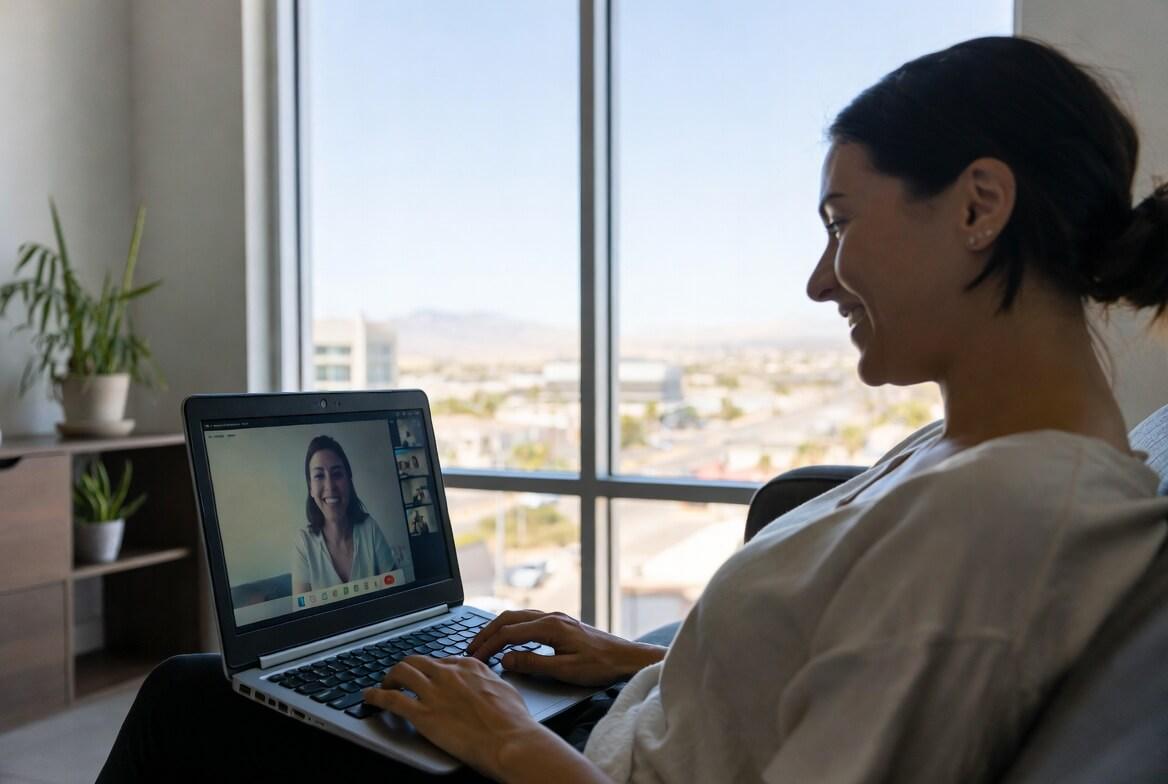
Telehealth weight loss allows patients to access physician-guided treatment, including GLP-1 medications and progress monitoring, without in-person visits. In Las Vegas, clinics like TrimBody M.D. use telehealth to combine medical oversight with convenience, improving access while maintaining clinical standards.
The value depends on patient needs, treatment complexity, and the level of supervision required. Book a consultation to understand self pay vs insurance weight loss options and what fits your budget and goals.
Key Takeaways:
- Telehealth improves access to medical weight loss care
- GLP-1 treatments can be prescribed remotely
- Monitoring remains essential for safety and results
- Convenience increases adherence and consistency
- Some cases still require in-person evaluation
What Telehealth Weight Loss Actually Includes
Telehealth weight loss is not limited to virtual consultations. It is a structured medical process delivered through digital platforms, designed to replicate key elements of in-clinic care. This includes physician evaluation, prescription management, progress tracking, and follow-up adjustments.
A typical telehealth program begins with a comprehensive health assessment.
Patients provide medical history, weight data, and lifestyle information. This allows physicians to evaluate eligibility for treatment and identify underlying metabolic conditions.
Once approved, treatment may include GLP-1 medications such as semaglutide or tirzepatide. These medications regulate appetite, slow gastric emptying, and improve insulin response. This leads to reduced caloric intake and more stable weight loss progression.
Telehealth also includes ongoing monitoring. Patients report progress, side effects, and changes in weight. Physicians adjust dosing and treatment plans based on this data. This maintains safety while optimizing results.
Access to a structured program through telehealth weight loss services allows patients to receive medical care without frequent clinic visits. This is particularly beneficial for individuals with limited time or mobility constraints.
Let our team know how we can help with your goals!
How Telehealth Weight Loss Compares To In-Clinic Programs
The effectiveness depends on how closely it mirrors in-person care. Both models aim to address metabolic drivers of weight gain, but they differ in delivery and interaction.
In-clinic programs provide direct physical assessments, including body composition scans and lab testing. These tools offer detailed insight into fat distribution, muscle mass, and metabolic markers.
Telehealth programs rely more on reported data and remote tracking. While this may limit certain measurements, it does not reduce the effectiveness of treatment when structured correctly. GLP-1 medications and physician oversight remain the primary drivers of results.
The Advantage
The main advantage of telehealth is accessibility. Patients can attend consultations, receive prescriptions, and follow up without travel. This reduces friction and improves adherence.
However, telehealth may not be suitable for all cases. Individuals with complex medical conditions or those requiring detailed diagnostics may benefit from in-person evaluation. In many cases, a hybrid model provides the best balance.
Clinics that integrate both approaches, such as a medical weight loss program with telehealth support, allow patients to transition between virtual and in-person care as needed.
Cost, Convenience, And Long-Term Value
Cost is a common concern when evaluating, but value extends beyond pricing. It includes accessibility, consistency, and long-term outcomes.
Costs
Telehealth programs often reduce overhead costs associated with clinic visits. This can result in more predictable pricing structures. Patients also save time and travel expenses, which improves overall efficiency.
Medication cost remains a primary factor. GLP-1 treatments vary in price depending on dosage and duration. Understanding how to access these treatments is important, and resources like getting semaglutide provide insight into the process.
Convenience
Convenience plays a significant role in adherence. Patients who can attend appointments from home are more likely to stay consistent with follow-ups. This improves long-term results.
Long-Term Value
From a clinical perspective, consistency is critical. Weight loss requires sustained intervention over time. Programs that reduce barriers to participation increase the likelihood of maintaining progress.
Telehealth also supports scalability. Patients can continue treatment even when traveling or relocating, which maintains continuity of care.
To discuss our services, contact us today!
Clinical Effectiveness And Safety Considerations
The effectiveness depends on proper medical oversight. When structured correctly, telehealth programs can achieve outcomes comparable to in-clinic care.
GLP-1 medications have demonstrated significant weight loss results in clinical studies, often ranging from 10% to 20% of body weight. These outcomes are driven by appetite regulation and metabolic improvements rather than calorie restriction alone.
Safety requires monitoring. Patients must report side effects such as nausea, fatigue, or changes in appetite. Physicians adjust dosing to balance effectiveness with tolerability.
Programs that lack supervision increase risk. Self-directed use of weight loss medications without medical guidance can lead to complications. Telehealth programs with physician involvement reduce these risks.
Another factor is patient selection. Not all individuals are ideal candidates for telehealth-only care. Medical history, current conditions, and treatment goals must be evaluated before starting a program. Access to treatments like semaglutide injections through telehealth expands options for patients who may not have local access to specialized clinics.
Need help deciding? Fill out a contact form,and we’ll ensure you’re informed!
Who Benefits Most From Telehealth Weight Loss?
Ideal candidates include:
- Individuals with busy schedules who cannot attend frequent clinic visits
- Patients are comfortable with digital communication and remote monitoring
- People seeking early intervention before conditions progress
- Individuals who require ongoing support but not intensive diagnostics
Patients with complex medical conditions may require in-person evaluation before transitioning to telehealth. This ensures accurate diagnosis and treatment planning.
How Our Telehealth Weight Loss Programs Deliver Real Results At Scale
At TrimBody M.D., our clinic has treated over 30,000 patients using physician-supervised programs that combine telehealth access with clinical precision. Our approach allows patients to begin treatment quickly while maintaining structured monitoring and evidence-based care throughout their journey.
Patients benefit from:
- Physician-guided evaluations before starting treatment
- Access to GLP-1 medications through telehealth programs
- Continuous monitoring with real-time adjustments
- Flexible care that transitions between virtual and in-person support
- Experience built from treating over 30,000 patients
Is Telehealth Weight Loss The Right Approach For You?
Telehealth weight loss provides a clinically guided, accessible option for individuals seeking effective weight management without frequent clinic visits. Programs that combine physician oversight, evidence-based treatments, and consistent monitoring deliver reliable outcomes while improving convenience. The right choice depends on your medical needs, lifestyle, and ability to stay engaged with structured care. Book your free consultation today.
FAQs about Telehealth Weight Loss
How Does Telehealth Weight Loss Work?
Yes, telehealth weight loss connects you with a physician remotely for evaluation and treatment. You receive prescriptions, guidance, and follow-ups without clinic visits.
Can You Get GLP-1 Medications Through Telehealth?
Yes, GLP-1 medications can be prescribed through telehealth after evaluation. Physicians monitor progress and adjust dosing as needed.
Is Telehealth Weight Loss As Effective As In-Person Care?
Yes, when supervised by a physician, telehealth can deliver similar results. Consistent monitoring and adherence drive outcomes.
Who Is A Good Candidate For Telehealth Weight Loss?
Busy individuals and those comfortable with remote care benefit most. It works best for patients who can stay consistent with follow-ups.
Are There Cases Where In-Person Visits Are Needed?
Yes, complex medical conditions may require in-person evaluation. Some patients benefit from a hybrid approach for better accuracy.
Call and talk to a specialist today! (702) 489-3300

 Henderson