
'%3e%3cpath%20d='M12.0979%2019.9987C10.6974%2019.9987%209.29703%2019.4657%208.2309%2018.3995L1.60176%2011.7704C0.568828%2010.7375%200%209.36414%200%207.9034C0%206.44262%200.568828%205.06934%201.6018%204.03641C2.51562%203.12254%204.00258%203.12262%204.91633%204.03637L7.12605%206.2461C8.03988%207.15992%208.03988%208.6468%207.12605%209.56067C6.97848%209.70821%206.89723%209.90442%206.89723%2010.1131C6.89723%2010.3218%206.97848%2010.5179%207.12602%2010.6655L9.33574%2012.8752C9.48328%2013.0228%209.67949%2013.1041%209.88816%2013.1041C10.0969%2013.1041%2010.293%2013.0228%2010.4406%2012.8753C11.3545%2011.9614%2012.8414%2011.9614%2013.7552%2012.8753L15.9649%2015.085C16.8787%2015.9988%2016.8787%2017.4857%2015.9649%2018.3995C14.8987%2019.4657%2013.4983%2019.9987%2012.0979%2019.9987ZM3.25906%204.91281C3.05898%204.91281%202.85895%204.98895%202.7066%205.14129C1.96883%205.87906%201.5625%206.86%201.5625%207.9034C1.5625%208.9468%201.96883%209.92774%202.7066%2010.6655L9.33574%2017.2947C10.8587%2018.8177%2013.337%2018.8177%2014.86%2017.2947C15.1646%2016.99%2015.1646%2016.4944%2014.86%2016.1898L12.6503%2013.9801C12.5028%2013.8325%2012.3066%2013.7513%2012.0979%2013.7513C11.8892%2013.7513%2011.693%2013.8325%2011.5455%2013.98C10.6316%2014.8939%209.14473%2014.8939%208.23086%2013.98L6.02117%2011.7703C5.57852%2011.3277%205.33473%2010.7391%205.33473%2010.113C5.33473%209.48703%205.57852%208.89844%206.02117%208.45578C6.16875%208.30824%206.25%208.11203%206.25%207.90336C6.25%207.69469%206.16875%207.49852%206.02117%207.35094L3.81148%205.14121C3.65918%204.98899%203.4591%204.91281%203.25906%204.91281Z'%20fill='black'/%3e%3cpath%20d='M9.5448%209.3168C9.25285%209.1959%209.0625%208.91102%209.0625%208.59504V0.782539C9.0625%200.351055%209.41227%200.00128937%209.84375%200.00128937H19.2188C19.6502%200.00128937%2020%200.351055%2020%200.782539V7.03254C20%207.46402%2019.6502%207.81379%2019.2188%207.81379H11.7298L10.3962%209.14746C10.1728%209.3709%209.83676%209.43773%209.5448%209.3168ZM10.625%201.56379V6.70895L10.8538%206.48012C11.0003%206.33359%2011.199%206.25129%2011.4062%206.25129H18.4375V1.56379H10.625Z'%20fill='black'/%3e%3cpath%20d='M12.9688%204.68879C13.4002%204.68879%2013.75%204.33901%2013.75%203.90754C13.75%203.47607%2013.4002%203.12629%2012.9688%203.12629C12.5373%203.12629%2012.1875%203.47607%2012.1875%203.90754C12.1875%204.33901%2012.5373%204.68879%2012.9688%204.68879Z'%20fill='black'/%3e%3cpath%20d='M16.0938%204.68879C16.5252%204.68879%2016.875%204.33901%2016.875%203.90754C16.875%203.47607%2016.5252%203.12629%2016.0938%203.12629C15.6623%203.12629%2015.3125%203.47607%2015.3125%203.90754C15.3125%204.33901%2015.6623%204.68879%2016.0938%204.68879Z'%20fill='black'/%3e%3c/g%3e%3cdefs%3e%3cclipPath%20id='clip0_6353_9'%3e%3crect%20width='20'%20height='20'%20fill='white'/%3e%3c/clipPath%3e%3c/defs%3e%3c/svg%3e)
'%3e%3cpath%20d='M10%2020C13.8389%2020%2017.0312%2018.3836%2017.0312%2016.0938C17.0312%2015.4405%2016.7592%2014.8022%2016.2444%2014.2478C15.9508%2013.9316%2015.4565%2013.9132%2015.1403%2014.2068C14.8241%2014.5004%2014.8058%2014.9947%2015.0994%2015.3109C15.3444%2015.5749%2015.4687%2015.8383%2015.4687%2016.0938C15.4687%2017.2001%2013.13%2018.4375%209.99996%2018.4375C6.86996%2018.4375%204.53121%2017.2001%204.53121%2016.0938C4.53121%2015.8382%204.65547%2015.5749%204.90055%2015.3109C5.19414%2014.9947%205.17582%2014.5004%204.85965%2014.2068C4.54348%2013.9133%204.04914%2013.9316%203.75555%2014.2477C3.24082%2014.8021%202.96875%2015.4405%202.96875%2016.0938C2.96875%2018.3803%206.15578%2020%2010%2020Z'%20fill='black'/%3e%3cpath%20d='M8.13172%2015.9465C8.57285%2016.5282%209.27023%2016.875%2010%2016.875C10.7298%2016.875%2011.4271%2016.5282%2011.8683%2015.9466L15.6293%2011.2402C16.5465%2010.0163%2017.0312%208.5609%2017.0312%207.03125C17.0312%203.15422%2013.877%200%2010%200C6.12297%200%202.96875%203.15422%202.96875%207.03125C2.96875%208.56094%203.45352%2010.0164%204.37063%2011.2402L8.13172%2015.9465ZM10%201.5625C13.0155%201.5625%2015.4688%204.01578%2015.4688%207.03125C15.4688%208.21648%2015.0944%209.34434%2014.386%2010.2938C14.386%2010.2938%2010.6309%2014.9924%2010.626%2014.9989C10.4766%2015.1982%2010.2484%2015.3125%2010%2015.3125C9.75156%2015.3125%209.5234%2015.1982%209.37402%2014.9989C9.36914%2014.9923%209.36418%2014.9859%209.3591%2014.9796L5.61395%2010.2937C4.90559%209.34434%204.53125%208.21652%204.53125%207.03125C4.53125%204.01578%206.98453%201.5625%2010%201.5625Z'%20fill='black'/%3e%3cpath%20d='M10%2010.9375C12.1539%2010.9375%2013.9062%209.18516%2013.9062%207.03125C13.9062%204.87734%2012.1539%203.125%2010%203.125C7.84609%203.125%206.09375%204.87734%206.09375%207.03125C6.09375%209.18516%207.84609%2010.9375%2010%2010.9375ZM10%204.6875C11.2923%204.6875%2012.3438%205.73891%2012.3438%207.03125C12.3438%208.32359%2011.2923%209.375%2010%209.375C8.70766%209.375%207.65625%208.32359%207.65625%207.03125C7.65625%205.73891%208.70766%204.6875%2010%204.6875Z'%20fill='black'/%3e%3c/g%3e%3cdefs%3e%3cclipPath%20id='clip0_6353_60'%3e%3crect%20width='20'%20height='20'%20fill='white'/%3e%3c/clipPath%3e%3c/defs%3e%3c/svg%3e)
'%3e%3ccircle%20cx='321'%20cy='321'%20r='276'%20transform='matrix(-1%200%200%201%20481%200)'%20stroke='%23E5DFD3'%20stroke-width='90'/%3e%3c/g%3e%3cdefs%3e%3cclipPath%20id='clip0_6046_3421'%3e%3crect%20width='481'%20height='413'%20fill='white'%20transform='matrix(-1%200%200%201%20481%200)'/%3e%3c/clipPath%3e%3c/defs%3e%3c/svg%3e)


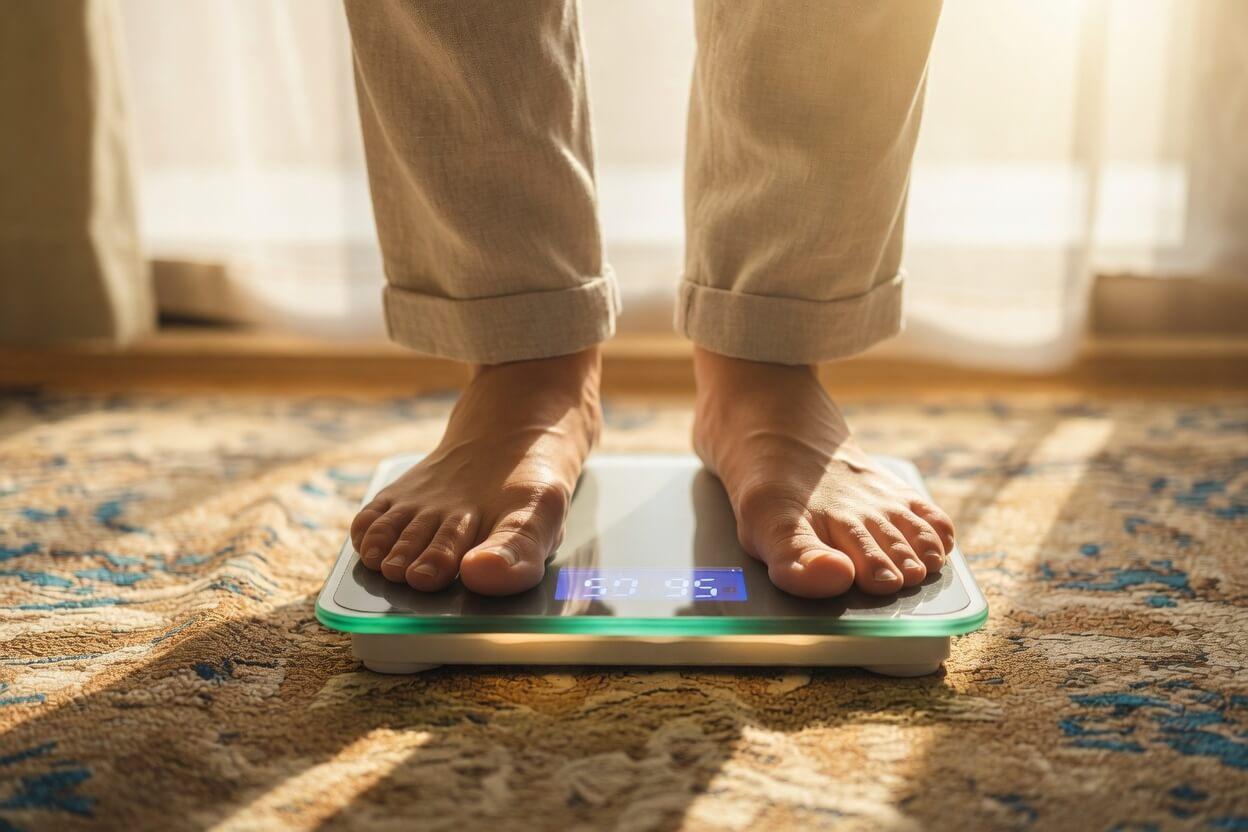
Tracking weight loss progress requires consistent measurement across weight, behavior, and body composition rather than relying on the scale alone. Structured tracking methods used by TrimBody M.D. in Costa Mesa help improve accuracy, reveal patterns, and support faster, safer fat loss results. Learn how to track weight loss progress accurately without relying only on the scale.
Key Takeaways:
- Daily tracking improves weight loss outcomes
- Scale weight alone is not enough
- Food logs increase consistency and awareness
- Digital tools improve accuracy and adherence
- Multiple metrics give a clearer progress picture
Why Weight Loss Progress Tracking Matters
Learning to track weight loss progress means understanding that fat loss doesn’t always follow a straight path, even when efforts feel consistent. Water retention, hormonal shifts, and daily changes in sodium intake can mask actual fat loss if you don’t track or in enough detail.
Tracking gives clear and reliable information to help avoid guessing. This allows people to make changes based on actual trends instead of relying on assumptions.
Research shows that staying consistent with self-monitoring has a strong connection to greater weight loss and better long-term results.
When people track their progress often, they are more likely to stick to habits that encourage fat loss, like keeping up with proper eating and exercise routines. This is why tracking isn’t just an option in supervised programs, it’s an essential part of the process.
Let our team know how we can help with your goals!
Most Effective Ways To Track Weight Loss Progress
Figuring out the best way to track weight loss works better when you use more than one measurement. Relying on just one number can give you a misleading idea of what’s happening. Here are some good ways to keep track:
- Body weight: Weigh yourself a few times each week to spot patterns instead of focusing on single-day results.
- Meal tracking: Write down what you eat to stay aware of your habits and manage your portions.
- Measurements: Measure your waist, hips, and other areas to notice changes in fat loss.
- Photos over time: Taking before-and-after pictures can show progress that the scale might not.
- Fitness progress: Keep an eye on how your strength, endurance, or activity levels are improving.
Research finds that monitoring habits even for part of the week can still lead to noticeable weight loss. Staying consistent enough to spot trends is key, but you don’t need to go overboard.
Digital tools like apps, smart scales, and fitness trackers make tracking easier and help people stick to it.
How Often Should You Track Your Weight Loss Progress
Tracking frequency plays a big role in figuring out how to track weight loss progress, as being inconsistent can give you bad info. Daily tracking gives you the best overview, even though numbers might shift from one day to the next.
Tracking progress weekly works, but it might miss quick changes that affect long-term results. Weighing yourself every day and then looking at the weekly average offers a clearer idea of fat loss over time.
Sticking to a regular tracking routine keeps you accountable.
How often to track:
- Step on the scale and calculate weekly averages
- Record what you eat on most days
- Check the measurements of your body areas weekly
- Snap progress photos every two to four weeks
This approach lowers the chance of overreacting to daily fluctuations and makes it easier to focus on bigger-picture trends.
To discuss our services, contact us today!
Mistakes That Hurt Tracking Accuracy
A lot of people find it hard to track progress because they use scattered or partial methods that mess up their results. These errors might make them feel fed up even when they are losing fat. Some frequent tracking errors are:
- Checking weight at random times
- Skipping details about food consumption
- Depending on scale numbers
- Being irregular with weekly tracking
- Giving up tracking after seeing small results
Study shows that people who stick to steady tracking habits see much better outcomes than those who track on and off.
Fixing these errors helps you get clearer data. It also makes it easier to see progress, which helps you make smarter choices during the process.
Need help deciding? Fill out a contact form,and we’ll ensure you’re informed!
Using Healthcare Advice To Track Better
Tracking works best when medical professionals oversee it to support those following structured weight loss plans or using medications. Doctors provide proper interpretation of the data and fine-tune strategies based on how the body reacts.
Patients working with a Costa Mesa clinic use organized tracking tools that bring together insights from several areas. They look at patterns like weight shifts, metabolic reactions, and daily behaviors.
For people managing their treatment with medications, tracking plays a key part. It helps monitor how the body responds and ensures safe dosage changes.
Medications like semaglutide injections and tirzepatide injections need ongoing tracking to improve results and limit unexpected fluctuations.
You can check out the expected timelines using GLP-1 results. This helps you understand how progress typically develops and what changes to expect at each stage.
How We Track Weight Loss Progress in Costa Mesa
At TrimBody M.D., we rely on detailed tracking systems that use real patient information. These systems have helped more than 30,000+ patients achieve noticeable and lasting weight loss. Our method combines medical expertise with regular check-ins to make results faster and more precise.
Benefits for patients:
- Doctors guide tracking plans to analyze progress
- Weight, diet, and metabolism data come together in one place
- Plateaus are spotted so adjustments can be made
- Regular monitoring supports medication programs
- Clear goals make staying consistent easier
This approach eliminates guessing and helps patients decide based on actual data instead of temporary changes.
Turn Tracking Into Consistent, Measurable Results
Understanding how to track weight loss progress comes down to consistency, structured data, and using multiple metrics beyond the scale. This approach removes guesswork and gives clear direction on what is working and what needs adjustment.
Consistent tracking across weight, nutrition, and performance helps identify patterns early and reduce frustration from normal fluctuations. It turns tracking into a reliable system that supports steady fat loss and more sustainable results. Start your consultation with us.
FAQs about Tracking Weight Loss Progress In Costa Mesa
What Is The Most Accurate Way To Measure Fat Loss?
Use a combination of body measurements, progress photos, and strength tracking for a clearer picture. These methods reveal fat loss changes that the scale alone often misses.
How Do I Know If My Weight Loss Has Stalled?
Look at trends across several weeks instead of single weigh-ins to confirm a plateau. If measurements and performance stay unchanged, adjustments in nutrition or activity may be needed.
Should I Track Calories Every Day To See Results?
Tracking most days builds awareness and helps maintain consistency without becoming overwhelming. Even partial tracking can improve outcomes if it reflects real eating habits.
Can Water Weight Affect My Progress Tracking Results?
Yes, hydration, sodium intake, and hormones can cause temporary weight fluctuations. Focus on weekly averages and supporting data instead of reacting to daily changes.
What Tools Make Tracking Weight Loss Progress Easier?
Mobile apps, smart scales, and wearable trackers simplify data collection and improve consistency. These tools help you stay accountable and make better decisions based on accurate information.
Call and talk to a specialist today! (702) 489-3300


 Henderson